Archilochus alexandri
Status: Increasing. Rare regular summer visitor west, rare casual elsewhere; rare casual breeder west.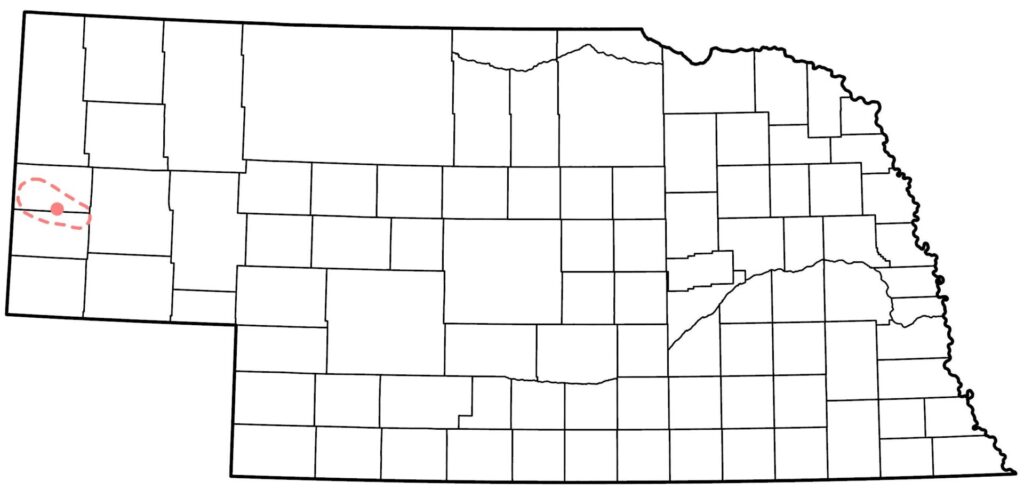
Documentation: Photograph: 7-8 May 2012 Scottsbluff, Scotts Bluff Co (DeLara and Smith 2013). See Comments.
Taxonomy: No subspecies are recognized (AviList 2025).
Hybridization with Ruby-throated Hummingbird was studied in Oklahoma, where ranges of the two species overlap (Judd et al 2011). The following is an excerpt: “During the course of this study, 30 adult male Ruby-throated hummingbirds, 77 adult male Black-chinned hummingbirds, and 11 male hybrids were banded. A total of 118 adult male hummingbirds were banded, with 9.3% of them being apparent hybrids. Banding 11 apparent male hybrids from 2006 to 2009 suggests that hybridization between the two Archilochus species in Oklahoma is widespread. …. Black-chinned Hummingbirds appear to be expanding their range farther north, causing more frequent overlap with Ruby-throated Hummingbirds.” Along the same lines, in reference to a male Black-chinned apparently paired “for several weeks” with a Ruby-throated in North Platte, Lincoln Co, Nebraska in Jun 2022, Sheri Williamson commented ““Sad to say that Black-chinneds are on the decline here in southeastern Arizona, but at least they seem to be taking advantage of new opportunities further north. It’ll be interesting to see if a new hybrid zone develops as Black-chinneds expand into areas with Ruby-throated populations.”
A possible Nebraska hybrid is discussed in Comments. A male Black-chinned Hummingbird was paired with a Ruby-throated Hummingbird 16-23 Jun 2022 at North Platte, Lincoln Co; the latter had been present “a few weeks”.
Summer: May 22, 24, 26 <<<>>>Aug 29, 29, 30
Earlier dates are 3 May 2025 male Croft feeders, Scotts Bluff Co, 7-8 May 2012 photographed Scottsbluff, Scotts Bluff Co photo (DeLara and Smith 2013, Brogie 2013), 11 May 2022 male Ogallala, Keith Co (Ochsner, eBird.org), 11 May 2026 Wildcat Hills NC, Scotts Bluff Co (eBird.org), 13 May 2019 male at Croft feeders (eBird.org), 13-19 May 2025 female Croft feeders, and 17-18 May 2026 Gering, Scotts Bluff Co (eBird.org).
Later dates are 3 Sep 2025 female Croft feeders, Scotts Bluff Co, 8-10 Sep 2022 at a Kearney Co feeder (Robin Harding, personal communication), 14 Sep 2023 Croft feeders, 13-16 Sep 2013 immature photographed Shelton, Buffalo Co (Brogie 2014), 29 Sep 2025 immature female Croft feeders, and 18 Sep-2 Oct 2018 at the Smith feeders, Scotts Bluff Co (eBird.org).
Males leave well before females; last dates for adult males in Nebraska are 1 Aug 2025 Turkey Drive, Scotts Bluff Co, 3 Sep 2025 at WHNC, Scotts Bluff Co, and 7 Sep 2025 at Wildcat Hills SRA, Scotts Bluff Co.
There are about 80 documented records, almost all from 2019-2026, indicating the steady increase in records since the first in 2012. In North America from 1970 to 2019, the continent-wide Black-chinned Hummingbird population increased by 52% (CI 16 to 98%) at a rate of 0.86% per year (CI 0.31 to 1.40% per year), although trend maps for this species from 2009 to 2019 reveal relatively stable or declining populations throughout most of the mapped region (English et al 2021).
There are three probable breeding records, assuming juveniles observed at feeders with an adult female were hatched locally.
The first indication of possible breeding was the appearance of an immature at the Croft feeders on Turkey Drive in Scotts Bluff Co 13 Jul 2023 (Steven Mlodinow, personal communication). In 2024, a male and a female were at the Croft feeders 24 Jun-11 Jul, although no breeding evidence was noted. Evidence was convincing in 2025. A female arrived on Old Stage Road, Scotts Bluff Co 13 May; possibly the same female was at the Croft feeders 20 May, soon joined on 21 May by a male, with copulation filmed 25 May by Colin Croft. Successful breeding was confirmed by the presence on 1 Aug of a female with two juveniles, while a male perched nearby. The role of this male is unknown; no pair bond is formed in this species (Baltosser and Russell 2020). Also in 2025, at Wildcat Hills NC, a female arrived 24 May, joined by a male 29 May, a male continuing almost daily through 30 Jul, with two males seen only once, on 13 Jun. Sightings of a female were intermittent, with only six reports 24 May-26 Jun, none in Jul, then a single female sighted 16 Aug-21 Sep. Breeding was indicated by a male in courtship display to a female 26 Jun, and appearance at the feeders of a female with a juvenile 17 Sep.
It is unknown whether sightings of males at Turkey Drive and WHNC in 2025 were different birds, or how many males in all were in the area. Males leave females after copulation with no pair bonding (Baltosser and Russell 2020), and so sightings are likely of several different wandering males.
Nebraska is east of the summer range and so sightings in the state would be expected to reflect spring migrants lead by males in May, summer vagrants, and fall migrants. The latter generally follow a pattern of adult males first, as early as late Jun, followed by adult females and young birds Jul-Aug (Baltosser and Russell 2020).
Records from the east and central are 11 May 2022 male Ogallala, Keith Co (Ochsner, eBird.org), 27 May 2026 North Platte, Lincoln Co (eBird.org), 29 Jun 2014, male photographed at a Lake McConaughy, Keith Co feeder 29 Jun 2014 (Brogie 2015), 30 Jun-17 Aug 2021 female/immature Lincoln, Lancaster Co (Michael Willison, eBird.org), 8 Jul 2017 and about a month prior, photographed Blair, Washington Co (Brogie 2018), 13-16 Sep 2013 immature photographed Shelton, Buffalo Co (Brogie 2014), and 16-23 Jun 2022 male paired with Ruby-throated Hummingbird present “a few weeks” North Platte, Lincoln Co.
Prior to the first record cited above, a female Archilochus hummingbird was observed at Kimball, Kimball Co 4 Aug 1996 (Grzybowski 1997) but not identified to species. A report of one at a Lake McConaughy feeder 28 Jul 2013 was not accepted by NOURC due to insufficient detail shown in the photograph submitted. A report including video of one in a Douglas Co yard 21 Aug 2015 (see Comments) was not accepted by NOURC based on an expert opinion that the evidence did not allow conclusive identification (Brogie 2016). Two “young birds” in a well-known hummingbird yard in Scotts Bluff Co 12 Aug 2016 were thought to be this species but were not photographed (eBird.org). A report of one in a Scotts Bluff Co yard 15 Aug 2017 was not accepted by NOURC due to “lack of detail” (Brogie 2018) but was likely correct. An immature photographed at the Croft feeders, Scotts Bluff Co 19 Sep 2018 was judged to be a Ruby-throated Hummingbird (eBird.org; Brogie 2019), while earlier at the same feeders, an immature Black-chinned Hummingbird was present at least 25-29 Aug (eBird.org); one or both of these immatures were present during 25 Aug-21 Sep (Colin Croft, eBird.org).
A puzzling bird with a strongly decurved bill in Lincoln, Lancaster Co 30 Jun-17 Aug (fide Michael Willison) was determined to be this species by Sheri Williamson albeit having a bill that was “on the decurved end of the bell curve”.
Comments: Bray et al (1986) discussed a specimen in the B. J. Olson collection at Kearney State College purportedly collected in Buffalo Co Aug 1903 by C. A. Black, but later determined by Swenk (1920) to have been purchased from an Arizona collector; Swenk (1920) removed the species from the state list. Swenk’s (1919) note that there was one Nebraska record of Black-chinned Hummingbird presumably refers to this 1903 specimen.
A videotape of what was thought to be a possible hybrid with Ruby-throated Hummingbird, taken in Omaha, Douglas Co 21-23 Aug 2015, was sent to experts Steven Mlodinow and Sheri Williamson (Justin Rink, personal communication). Both agreed that the bird was at least a “probable” Black-chinned Hummingbird; Williamson noted: “I see … a probable female Black-chinned. Apparent lack of a tail notch is a further point of evidence in favor of Black-chinned …; she doesn’t pump her tail when hovering between feeding bouts, but that’s not an infallible Black-chinned characteristic.” The report was judged “Not Accepted” by NOURC based on uncertainty of the identification (Brogie 2016).
An idea of the abundance of Black-chinned Hummingbird in western Kansas in 2015 comes from a veteran observer, Tom Shane: “… we finally had a nice wave of Archilochus hummingbirds arriving on 8 Sept 2015. … I am guessing we had a ratio of 70 BCHUs to 30 RTHUs. We still had 2 Black-chins and one probable Ruby-throat today 3 Oct 2015. Black-chins nested this year 30 miles west of the Kansas – Colorado line in Lamar, CO. We have not had an adult male BCHU here in Garden City in a number of years.” Joseph Grzybowski (personal communication) noted in 2019 for Oklahoma “In 1993, there was a surge of Black-chinned Hummingbirds into the Wichita Mountains at least” and “In recent decades Black-chinned Hummingbirds began to expand into central Oklahoma such that one can no longer assume a hummingbird in, say, Oklahoma City or Cleveland County is a Ruby-throated.” Ted Floyd noted in Jul 2024 that Black-chinned Hummingbird “continues its inexorable march across western Weld Co” Colorado (post to COBIRDS 7 Jul 2024).
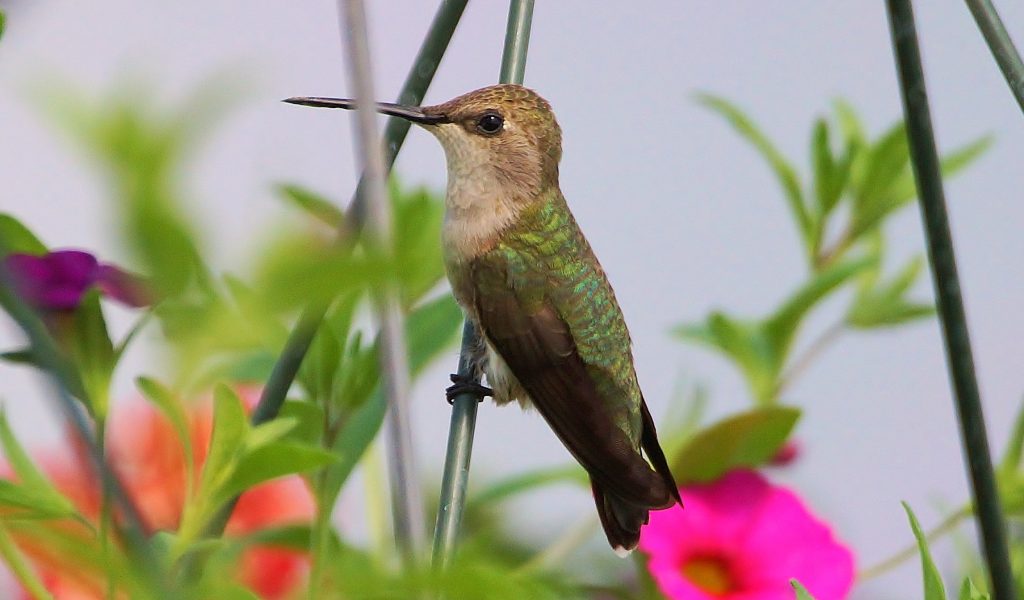
Images


Abbreviations
NOURC: Nebraska Ornithologists’ Union Records Committee
SRA: State Recreation Area
WHNC: Wildcat Hills Nature Center
Literature Cited
AviList Core Team, 2025. AviList: The Global Avian Checklist, v2025. https://doi.org/10.2173/avilist.v2025.
Baltosser, W.H., and S.M. Russell. 2020. Black-chinned Hummingbird (Archilochus alexandri), version 1.0. In Birds of the World (A. F. Poole and F. B. Gill, Editors). Cornell Lab of Ornithology, Ithaca, NY, USA. https://doi.org/10.2173/bow.bkchum.01.
Bray, T.E., B.K. Padelford, and W.R. Silcock. 1986. The birds of Nebraska: A critically evaluated list. Published by the authors, Bellevue, Nebraska, USA.
Brogie, M.A. 2013. 2012 (24th) Report of the NOU Records Committee. NBR: 81: 120-130.
Brogie, M.A. 2014. 2013 (25th) Report of the NOU Records Committee. NBR 82: 131-146.
Brogie, M.A. 2015. 2014 (26th) Report of the NOU Records Committee. NBR 83: 125-138.
Brogie, M.A. 2016. 2015 (27th) Report of the NOU Records Committee. NBR 84: 138-150.
Brogie, M.A. 2018. 2017 (29th) Report of the NOU Records Committee. NBR 86: 130-142.
Brogie, M.A. 2019. 2018 (30th) Report of the NOU Records Committee. NBR 87: 96-109.
Brogie, M.A. 2020. 2019 (31st) Report of the NOU Records Committee. NBR 88: 124-134.
DeLara, K., and M. Smith. 2013. First documented Nebraska record of Black-chinned Hummingbird (Archilochus alexandri). NBR 81: 30-32.
English, S.G., C.A Bishop, S. Wilson, and A.C. Smith. 2021. Current contrasting population trends among North American hummingbirds. Scientific Reports doi: 10.1038/s41598-021-97889-x.
Grzybowski, J.A. 1997. Southern Great Plains Region. Field Notes 51: 78-82.
Judd, E.R., C.J. Butler, and N. Batchelder. 2011. Hybridization between Black-chinned (Archilochus alexandri) and Ruby-throated (A. colubris) hummingbirds in Oklahoma. Bulletin of the Oklahoma Ornithological Society 44: 1–7.
Swenk, M.H. 1919. The Birds and Mammals of Nebraska. Contributions of the Department of Entomology No. 23. Lincoln, Nebraska.
Swenk, M.H. 1920. The Birds and Mammals of Nebraska. Nebraska Blue Book, p. 464.
Recommended Citation
Silcock, W.R., and J.G. Jorgensen. 2026. Black-chinned Hummingbird (Archilochus alexandri). In Birds of Nebraska — Online. www.BirdsofNebraska.org
Birds of Nebraska – Online
Updated 8 Jun 2026, map added 20 July 2026