Thryothorus ludovicianus ludovicianus
Status: Common regular resident southeast and southern east central, rare casual elsewhere. Rare regular summer visitor north and west of resident range. Rare casual winter visitor north and west of resident range.
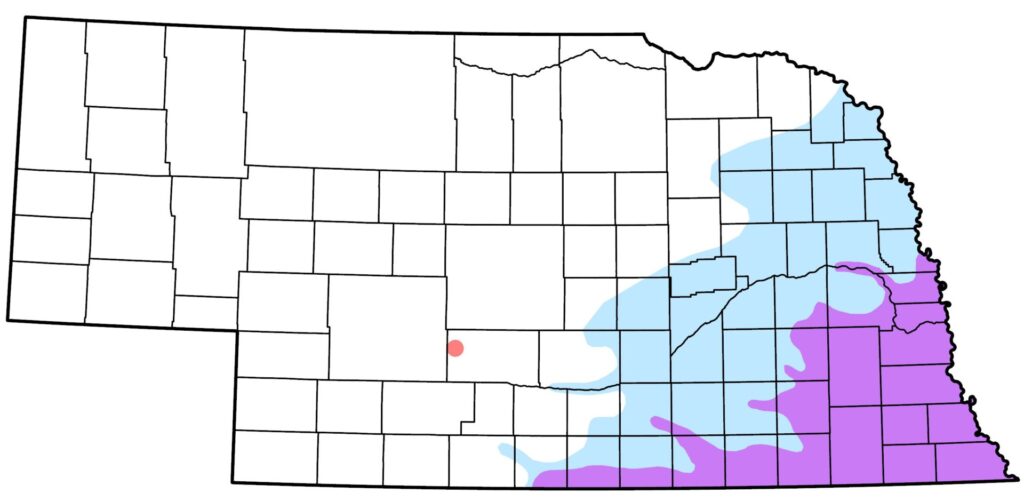
Documentation: Specimen: UNSM ZM11643, 27 Dec 1911 Rulo, Richardson Co.
Taxonomy: Ten subspecies are recognized (AviList 2025); of five that occur entirely north of Mexico, ludovicianus is found over most of the eastern US range, north of Florida, the Gulf Coast, and southern Texas.
Nebraska birds are ludovicianus (Phillips 1986, Rapp et al 1958).
Resident: Carolina Wren is sedentary as a breeding species; it is at the northwest edge of its eastern US breeding range in southeast Nebraska. Because of its sensitivity to cold weather, the extent of its year-round distribution in the state has varied considerably over the years, notably affected by the severe winter of 1976-77. Such hard winters can devastate local populations, but after a few years numbers slowly replace losses. In the 20th century, severe winters have been infrequent enough to allow such replacement of losses and even a slow expansion of the range northwestward, aided in urban areas by feeder stations (Haggerty and Morton 2020). Data from the range periphery indicate that summer and fall dispersal, coupled with ability to survive the subsequent winter, is the probable manner by which the species expands its range. Few dispersers, however, establish breeding populations (Haggerty and Morton 2020).
Around 1900, Carolina Wren was rare in Nebraska; Bruner et al (1904) cited only three records, two older reports in Richardson Co and one in Lancaster Co, the latter a specimen collected 20 Feb 1902 by Wolcott (1902), who suggested it was “probably a rare resident in the extreme southeastern part of the state”. By the 1950s, however, the species was occupying a summer range not unlike the current mapped range in the southeast (Rapp et al 1958), but with only these reports of nesting since Bruner et al (1904) and prior to winter 1976-1977: a nest with a nestling was at Superior, Nuckolls Co 10 Jun 1928 (Johnston 1928), another nest there with adults feeding young was found 4 May 1934 and a second clutch was laid by 7 Jun (Johnston 1934), and young were seen 13 Jul 1965 in Adams Co (Bennett 1967). Several additional summer reports in the south, westward to Lincoln and Perkins Cos, prior to winter 1976-1977, were probably of spring-summer-fall dispersers, including a specimen, HMM 2894, collected at Inland, Clay Co 6 May 1923.
The best-known major weather event affecting Nebraska Carolina Wrens was the severe winter of 1976-1977. During the five subsequent years, reports were few and restricted mostly to summer months; none were reported on CBCs for five years. Since the winter of 1976-1977, numbers have fluctuated widely as a result of a few harder than average winters, and a few notable dispersal events. Although the breeding range was said to have extended slowly after 1977 north to Dakota, Dixon, and Knox (Grzybowski 1992) Cos, and west to Lancaster (Williams 1976), Clay (Silcock 1995), and Harlan Cos, from 2009-2014 probable and confirmed breeding was documented north and west only to Douglas, Lancaster, and Thayer Cos (Mollhoff 2016). The “breeding range” records mentioned above for Dakota, Dixon, and Knox Cos probably are referable to summer visitors. Carolina Wrens established at Wilderness Park, Lincoln, Lancaster Co in the late 1990s and are still extant there, despite being nearly extirpated by the winter of 2000-2001.
Breeding records since 1977 outside the mapped resident range follow. There was an undocumented breeding record for Cherry Co in the period 1984-89 (Mollhoff 2001). A small number became established at Harlan Co Reservoir in 1998, and the species has been established in the area since, although may have been temporarily extirpated by the winter of 2000-2001, although birds re-appeared by the following Aug. It is possible this population departed and returned after the winter rather than simply perishing. One was singing at McCook, Red Willow Co 21 Jul 2005, and breeding was confirmed there with one of two pairs carrying nest material 1 May 2006. Reports at McCook persisted through at least 2009; one was there 22 Jul 2026. A pair nested at Gothenburg, Dawson Co 6 Jun 2014. Since 2010, a population has established in Buffalo Co; there are about 42 reports there since 2006 from 2 Apr-1 Sep, 27 of these since 2020.
Notable dispersal events since 1977 were few until major events in the falls of 2019, 2020, and 2025, bolstered by a similar event in spring 2025; these have contributed to the numerous distributional records north and west of the current mapped breeding range, most, as expected, in and near riparian habitats. In the Panhandle, the only records are 21 Jun 2024 Kimball Co and 14 Jul 2019 Oliver Reservoir, Kimball Co. In the west central and northern east central, there are about 61 records, 12 of these in May and 29 in Jun-Sep, suggesting main periods of dispersal, and 20 records from Oct-Apr. Westernmost records in major drainages are: in the Niobrara Valley, 21 Apr 2017 Fort Niobrara NWR, Cherry Co, 6 Jul 2014 Valentine NWR, Cherry Co; in the Loup Drainages, 3 Jul 2015 Blaine Co, 16 Jun 2018 Loup Co, and 6 Aug 2000, 27 May 2016, and 18 May 2025 Custer Co; in the North Platte Valley, 17 Jun-22 Jul 2024, 18 Aug 2020, and 30 Dec 2003 Keith Co; and in the Republican Valley, 2 Oct 2020 (2 locations) Swanson Reservoir, Hitchcock Co. Reports in the west central away from these major drainages are 13 Jun 2011 Curtis, Frontier Co, 15 May 2014 Medicine Creek SRA, Frontier Co, 14 May 2010 Hayes Co, 18 Aug 2009 Chase Co, and 13-14 Sep 2019 (2 locations) Chase Co.
In addition to the westerly reports cited above, a noteworthy record is the first county record for Antelope Co 24-28 Nov 2012.
-
- Breeding phenology:
Nest building: 11 Mar-6 Aug
Eggs: 28 Mar-27 Aug
Nestlings: 28 Apr-20 Jun
Fledglings: 5 May-26 Aug - Adults with three young were building a second nest at Bellevue, Sarpy Co 6 Jun.
- High counts: 10 at Fontenelle Forest 1 Apr 2017, 9 there 1 May 2018, and 9 there 18 Apr 2026.
- Breeding phenology:
Winter: Winter reports (Oct-May) have increased in recent years; as of Aug 2026, Carolina Wrens may occur anywhere south and east of a line from Knox Co to Harlan Co. Many of the more northwesterly locations inside this line also have summer records (see Resident). Outside the line, there are about 20 reports, seven of these for Lincoln Co and one for Keith Co, the latter 30 Dec 2003. The other reports are 21 Apr 2017 Valentine NWR, Cherry Co, 16 Mar 2015 Brown Co, 20 Jan 2019 Bassett, Rock Co, 13 Mar 2008 Dawson Co, 19 Mar 2008 and 5 Apr 2010 Gosper Co, 2 Oct 2020 (2 locations) Hitchcock Co, 28 Feb 2026 Medicine Creek Trail, Furnas Co, 22 Apr 2009, 31 Dec 2025, and 19 Feb (no year) Indianola, Red Willow Co.
The state CBC high was 48 at Omaha 15 Dec 2012.
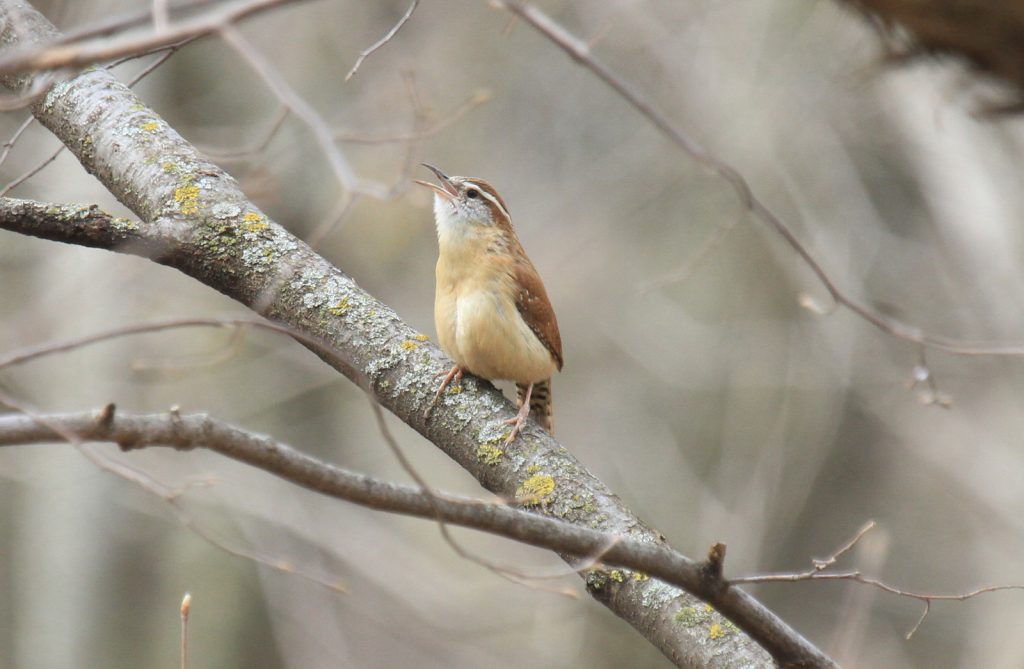
Images
Abbreviations
CBC: Christmas Bird Count
HMM: Hastings Municipal Museum
NWR: National Wildlife Refuge
SP: State Park
UNSM: University of Nebraska State Museum
Literature Cited
AviList Core Team, 2025. AviList: The Global Avian Checklist, v2025. https://doi.org/10.2173/avilist.v2025.
Bennett, E.V. 1967. 1967 Nebraska nesting survey. NBR 36: 35-42.
Bruner, L., R.H. Wolcott, and M.H. Swenk. 1904. A preliminary review of the birds of Nebraska, with synopses. Klopp and Bartlett, Omaha, Nebraska, USA.
Grzybowski, J.A. 1992. Southern Great Plains Region. American Birds 46: 1151-1152.
Haggerty, T.M. and E.S. Morton. 2020. Carolina Wren (Thryothorus ludovicianus), version 1.0. In Birds of the World (A. F. Poole, Editor). Cornell Lab of Ornithology, Ithaca, NY, USA. https://doi.org/10.2173/bow.carwre.01.
Job, J., and P.A. Bednekoff. 2011. Wrens on the edge: Feeders predict Carolina Wren Thryothorus ludovicianus abundance at the northern edge of their range. Journal of Avian Biology 42: 16-21.
Johnston, H.C. 1928. Report submitted to M.H. Swenk. Letter of Information 32: 9-10.
Johnston, H.C. 1934. The Eastern Carolina Wren again nests at Superior in 1934. NBR 2: 62.
Mehlman, D.W. 1997. Change in avian abundance across the geographic range in response to environmental change. Ecological Applications 7: 614-624.
Mollhoff, W.J. 2001. The Nebraska Breeding Bird Atlas 1984-1989. Nebraska Ornithologists’ Union Occasional Papers No. 7. Nebraska Game and Parks Commission, Lincoln, Nebraska, USA.
Mollhoff, W.J. 2016. The Second Nebraska Breeding Bird Atlas. Bull. Univ. Nebraska State Museum Vol 29. University of Nebraska State Museum, Lincoln, Nebraska, USA.
Phillips, A.R. 1986. The known birds of North and Middle America. Part 1. Published by the author, Denver, Colorado, USA.
Rapp, W.F. Jr., J.L.C. Rapp, H.E. Baumgarten, and R.A. Moser. 1958. Revised checklist of Nebraska birds. Occasional Papers 5, Nebraska Ornithologists’ Union, Crete, Nebraska, USA.
Silcock, W.R. 1995. Spring Field Report, March-May 1995. NBR 63: 34-60.
Williams, F. 1976. Southern Great Plains Region. American Birds 30: 972-975.
Wolcott, R.H. 1902. A review of Nebraska ornithology. Proceedings Nebraska Ornithologists’ Union 3: 93-105.
Recommended Citation
Silcock, W.R., and J.G. Jorgensen. 2026. Carolina Wren (Thryothorus ludovicianus). In Birds of Nebraska — Online. www.BirdsofNebraska.org
Birds of Nebraska – Online
Updated 5 Sep 2026; map updated 17 Mar 2026