Alopochen aegyptiacus
Status: No accepted records.
Taxonomy: No subspecies are recognized (AviList 2025).
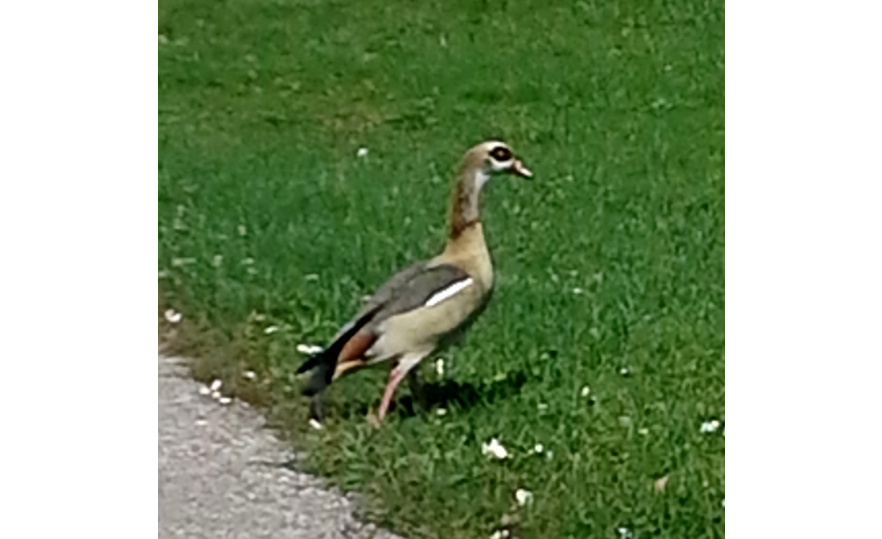
Comments: This species, actually a shelduck, has no history of wild vagrancy to the Western Hemisphere; it is assumed it established in North America as a result of escaped and/or released birds (Callaghan et al 2020). It has been reported a few times in Nebraska with no discernible pattern of occurrence; all were presumed escaped or released birds, although the species is capable of dispersing up to 1000 km (600 mi; Huysentruyt et al 2020).
Species maps in eBird (accessed Apr 2023) show established populations in northwestern Arkansas and large Texas cities Houston, San Antonio, Austin, and Dallas, as well as Dawson Co in northwestern Texas and Curry Co in eastern New Mexico. eBird reports in Oklahoma, Kansas, Missouri, South Dakota, and Iowa, as well as Nebraska, are not considered to represent established populations. As of Apr 2023, there are no eBird reports for Colorado. The closest established population to Nebraska is in northwestern Arkansas, where there has been an established and expanding population since the 1980s (Smith and James 2012). According to Chesbro (2015), “A final recommendation of this study proposes that northwestern Arkansas is a dispersal point for the Egyptian Goose for more suitable habitats in surrounding areas and should be eradicated from the area before the species follows other non-native species and becomes invasive.”
The several Nebraska reports include 1 Jan 2006 with Canada Geese near Ponca SP, Dixon Co; 11 Mar 2006 Merrick Co, 29 Mar (year unknown) photographed at Elkhorn, Douglas Co; 27 Apr 2003 Dixon Co; 28 May 2016 Kirkpatrick Basin North WMA, York Co; 6 Aug 2016 photographed near Garrison, Butler Co; specimen, UNSM ZM16013, an immature male that hit a powerline Sep 1988 in Gage Co and had a clipped tail suggesting it was an escapee (Thomas Labedz, personal communication); 12 Sep 2021 (3) at Lakeland Estates, Washington Co; 6-11 Oct 2014 photographed at Branched Oak Lake, Lancaster Co (Michael Willison, personal communication); 11 Oct 1999 Calamus Reservoir, Garfield Co (Wayne Mollhoff, personal communication); and 13 Dec 2016 at Holmes Lake, Lincoln, Lancaster Co. Singles were reported in 2023 at three Omaha, Douglas Co locations 7 Jul 2023 Heartland of America Park, 14 Aug Baxter Arena (Nick Mitzlaff fide Kristin Carder) and 11 Sep Miller’s Landing (Megan Neve). One was at Fontenelle Park, Douglas Co 7 Sep 2024.
Apparently free-flying birds have been reported with Canada Geese and Mallards at Henry Doorly Zoo, Douglas Co since 2021. Best counts there are five on 15 Nov 2017 and four on 6 Sep 2024.
Images
Abbreviations
SP: State Park
UNSM: University of Nebraska State Museum
WMA: Waterfowl Management Area (State)
Literature Cited
AviList Core Team, 2025. AviList: The Global Avian Checklist, v2025. https://doi.org/10.2173/avilist.v2025.
Callaghan, C.T., D.M. Brooks, and P. Pyle. 2020. Egyptian Goose (Alopochen aegyptiaca), version 1.0. In Birds of the World (S. M. Billerman, Editor). Cornell Lab of Ornithology, Ithaca, NY, USA. https://doi.org/10.2173/bow.egygoo.01.
Chesbro, C.R. 2015. Distribution of the Egyptian Goose (Alopochen aegyptiacus) in northwestern Arkansas and in the United States of America. Master’s Thesis, University of Arkansas, Fayetteville, Arkansas, USA.
Huysentruyt, F., T Adriaens, J.F. Maillard, A. Conn, A.E. Dunham, and D.M. Brooks. 2020. Chapter 28: Egyptian Goose (Alopochen aegyptica Linnaeus 1766). Pp. 206-212 In Global trends and impacts of alien invasive birds (Downs, C.T., and L.A. Hart, Eds). CABI, Wallingfprd, UK.
Smith, K.G., and D.A. James. 2012. History and current status of Egyptian Goose (Alopochen aegyptiacus) in northwestern Arkansas. Journal of the Arkansas Academy of Science 66: 200-204.
Recommended Citation
Silcock, W.R., and J.G. Jorgensen. 2026. Egyptian Goose (Alopochen aegyptiacus). In Birds of Nebraska — Online. www.BirdsofNebraska.org
Birds of Nebraska – Online
Updated 7 Jun 2026