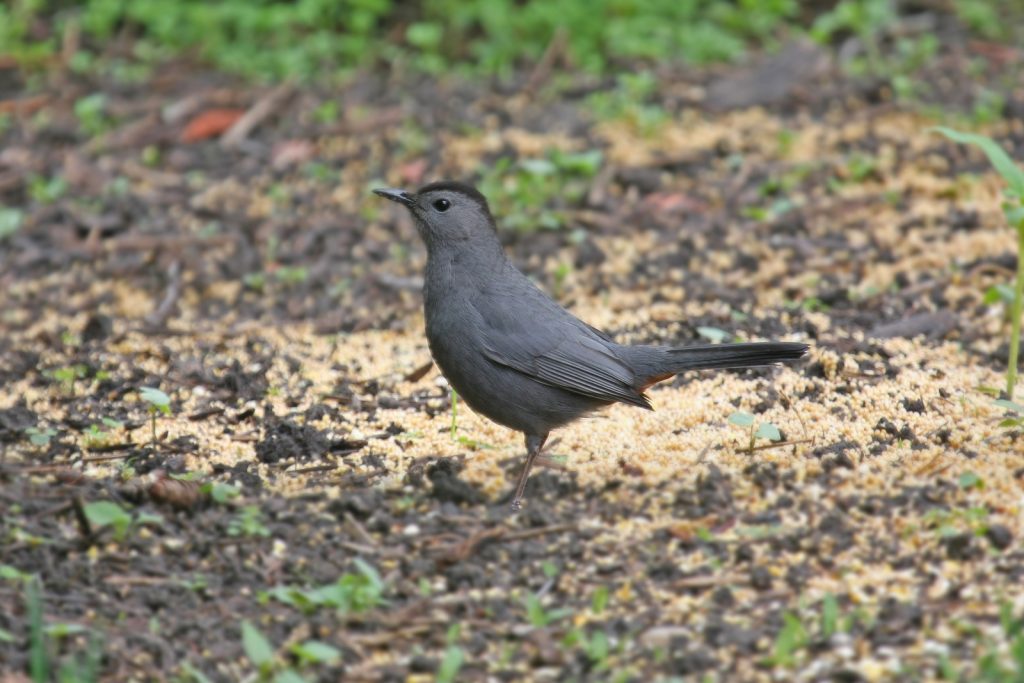
Dumetella carolinensis carolinensis
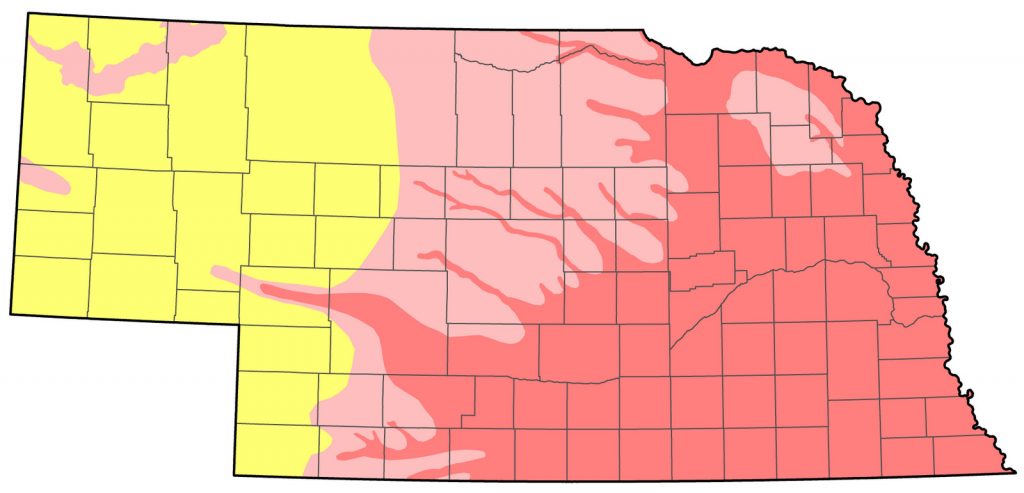
Status: Common regular spring and fall migrant east and central, uncommon west. Common regular breeder east and east central, uncommon west central and west. Rare casual winter visitor south and southeast.
Documentation: Specimen: UNSM ZM11666, 18 May 1907 Omaha, Douglas Co.
Taxonomy: No subspecies are recognized (AviList 2025).
Two weakly differentiated subspecies are sometimes recognized, carolinensis, breeding from southeast Manitoba east to Nova Scotia and south to east Texas and central Florida, and ruficrissa, breeding from southern British Columbia east to western North Dakota and south to western Oklahoma and west Texas (Phillips 1986, Smith et al 2020).
The above range descriptions suggest that both subspecies might occur in Nebraska, ruficrissa perhaps restricted to the Pine Ridge and the extreme western North Platte River Valley. Although there are no confirmed records of breeding on the Pine Ridge, Faulkner (2010) showed Gray Catbird, subspecies ruficrissa, summering over most of Wyoming, the northwest Panhandle of Nebraska, and the southwest corner of South Dakota. Faulkner (2010) stated also that catbirds in Wyoming are most common in “lowland cottonwood riparian corridors”, including the North Platte River Valley. Thus, eastern and western birds may meet there, and, if so, catbirds in the western North Platte Valley in Nebraska are probably intergrades of the two subspecies. The subspecific identity of catbirds recently reported on the Pine Ridge is unknown.
Spring: Apr 15, 16, 17 <<<>>> summer (east), Apr 27, 27, 27 <<<>>> summer (central), May 1, 1, 1 <<<>>> summer (west)
Earlier dates in the east are 30 Mar 2010 Otoe Co, and 7 Apr 2005 Nemaha Co.
Earlier dates in the central are 20 Apr 2025 Frontier Co, and 24 Apr 2015 Lincoln Co.
An earlier date in the west is 23 Apr 2026 Dawes Co.
In the Panhandle and western Sandhills, where the species is uncommon in summer, migrants are reported mostly in the second half of May, about a month later than in the east.
Remarkable for both age and origin of the bird, one captured in Sarpy Co 15 May 2002 by Ruth Green had been banded as a hatch-year bird in Rhode Island in 1991 (Silcock 2002).
A study by Jorgensen and Brenner (2024) found that spring arrival dates had advanced by 12 days from 1938 to 2024.
- High counts: 108 in Hall Co 11 May 2002, 98 in Hall Co 13 May 2006, 75 at Wilderness Park, Lancaster Co 11 and 13 May 2021, and 55 at Conestoga Lake, Lancaster Co 13 May 2023.
Summer: Gray Catbird breeds commonly throughout the east and east central, but numbers decline westward as habitat becomes restricted to riparian corridors. Wayne Mollhoff (personal communication) described the species as a “rare, highly localized breeder in the west”. In recent years, however, reports in the Panhandle are increasing; in Jun-Jul 2023 and 2024 together there were 28 reports, 32% of the 87 total reports for the last 10 years (2015-2024).
On the Pine Ridge, Rosche (1982) noted that while it “presumably breeds” in the northwest, there was no definite evidence, despite several prior summer reports for Sioux, Dawes, Scotts Bluff, and Garden Cos. It may have been more numerous on the Pine Ridge formerly, as suggested by Bruner et al (1904) and Rapp et al (1958), and the statement by Rosche (1982) that “It was probably more common formerly when destruction of riparian habitat was less extensive”. There were 11 additional records of “Possible” or “Probable” nesting 2009-2014 (Mollhoff 2016), indicative of an increase in summering numbers there, as well as these additional recent reports: singles were at Ponderosa WMA, Dawes Co 10 Jun 2015, Chadron SP, Dawes Co 11 Jun 2015, Fort Robinson SHP, Dawes Co 20 Jun 2011, and one was at Chadron SP, Dawes Co 19 Jul 2012.
In the western Sandhills Mollhoff (2016) showed only a single report, of “Possible” nesting at Smith Lake WMA, Sheridan Co 23 Jun 2003. Since then reports in the western Sandhills are few, all since 2017; additional reports for Smith Lake WMA are of singles 8 Jun 2025, 16 Jun 2018, 26 Jun 2026, and 1 Jul 2017. One was at Lakeside, Sheridan Co 29 Jun 2022. Reports at Crescent Lake NWR, Garden Co are 13 Jun 1987 and 19 Jul 2022. Two were at Alliance, Box Butte Co 19 Jun 2017, and another was there 5 Jun 2023. Westerly reports in the west central are for Grant Co 18 Jun 2026 and 18 Jun 2025, Arthur, Arthur Co 17 Jul 2026, McPherson Co 9 Jun 2024, and Hooker Co 7 Jun 2025 and 14 Jun 2024.
In the North Platte River Valley, nesting was first recorded in Keith Co in 1984 (Johnsgard 1990); the species was only a migrant prior to then (Rosche and Johnsgard 1984). Rosche (1994) indicated that regular breeding occurs westward to Sutherland, Lincoln Co and Paxton, Keith Co, and it was a “common breeder” in the Lake Ogallala area in Keith Co by the 1990s (Brown et al 1996). Mollhoff (2016) showed confirmed breeding at Ash Hollow SHP, Garden Co. Currently, there are several Jun-Jul reports west to Scotts Bluff Co without evidence of nesting; one in a yard south of Gering 10 Jul 2010 was “a surprise” (Alice Kenitz, personal communication).
South of the Platte River Valley, breeding is common west to Hayes and Hitchcock Cos; there is only one Jun-Jul record farther west suggestive of breeding, 18 Jul 2020 in Dundy Co; three records in early Jun (2-8 Jun) for Chase and Perkins Cos may be of spring migrants (eBird.org, accessed Nov 2023).
BBS trend analysis (Sauer et al 2020) shows an annual increase of 0.61 (95% C.I.; -0.19, 1.47) statewide 1966-2019, indicating populations have remained relatively stable during the period.
- Breeding phenology:
Nest-building: 5 May- 28 Jul
Eggs: 6 May-8 Aug (Mollhoff 2022)
Nestlings: 24 May- 26 Jul
Fledglings: 31 May-31 Jul - High counts: 50 at Wildwood WMA, Lancaster Co 15 Jul 2022, 44 at Fontenelle Forest, Sarpy Co 16 Jul 2022, 42 at Cunningham Lake, Douglas Co 11 Jun 2026, and 39 at Branched Oak Lake, Lancaster Co 17 Jul 2025.
Fall: summer <<<>>> Oct 10, 11, 11 (west and north); summer <<<>>> Nov 17, 17, 19 (south and east)
Later dates north and west are 18 Oct 2022 Sioux Co, 19 Oct 2019 Smith Lake WMA, Sheridan Co, 29 Oct 2003 Wind Springs Ranch, Sioux Co, 30 Oct 2022 Gering Cemetery, Scotts Bluff Co, Wind Springs Ranch 2 Nov 2005, 4 Nov 2004 Thomas Co, 9 Nov 2013 Garden Co, and 25 Nov 2024 Banner Co.
Later dates south and east are 17 Nov 2013 Washington Co, 19 Nov 2016 Douglas Co, 23 Nov 2001 near Gibbon, Buffalo Co, 27 Nov 2020 Hershey WMA, Lincoln Co, and 27 Nov 2020 Sutherland Reservoir, Lincoln Co.
Some small-scale loose grouping may occur by late Jul; 24 were in Lancaster Co 21 Jul 2006. Migration begins in mid-Sep and ends by early Oct in the Panhandle, and by late Oct in most of the state.
- High counts: 44 at Cunningham Kake, Douglas Co 7 Sep 2025, 37 at Stagecoach Lake SRA, Douglas Co 28 Aug 2025, and 36 at Wilderness Park, Lincoln, Lancaster Co 12 Sep 2018.
Winter: The only documented report of overwintering was in a Lincoln, Lancaster Co yard 2 Dec 2019- 22 Jan 2020.
Dec-Mar reports anywhere in the state are few. Ot the 26 records Dec-Mar, 18 are for Dec through 8 Jan, and these through 28 Feb: 22 Jan 2005 Wilsonville, Furnas Co, 3 Mar 2026 Lancaster Co, 30 Jan 2015 Bellevue, Sarpy Co, 7-8 Feb 1993 Douglas Co (Grzybowski 1993), 21 Feb 2024 Lake McConaughy, Keith Co, 25 Feb 2024 Cass Co, 2 Mar 2022 Fontenelle Forest, Sarpy Co, and 30 Mar 2010 Otoe Co.
The only Dec-Mar reports in the northeast, north, and northwest are 9-28 Dec 2021 Madison Co, 3 Jan 2026 Calamus-Loup CBC, Loup Co, and 4 Jan 2000 James Ranch, Sioux Co.
Images
Abbreviations
BBS: Breeding Bird Survey
NWR: National Wildlife Refuge
SHP: State Historical Park
SP: State Park
UNSM: University of Nebraska State Museum
WMA: Wildlife Management Area (State)
Literature Cited
AviList Core Team, 2025. AviList: The Global Avian Checklist, v2025. https://doi.org/10.2173/avilist.v2025.
Brown, C.R., M.B. Brown, P.A. Johnsgard, J. Kren, and W.C. Scharf. 1996. Birds of the Cedar Point Biological Station area, Keith and Garden Counties, Nebraska: Seasonal occurrence and breeding data. Transactions of the Nebraska Academy of Sciences 23: 91-108.
Bruner, L., R.H. Wolcott, and M.H. Swenk. 1904. A preliminary review of the birds of Nebraska, with synopses. Klopp and Bartlett, Omaha, Nebraska, USA.
Faulkner, D.W. 2010. Birds of Wyoming. Roberts and Company, Greenwood Village, Colorado, USA.
Grzybowski, J.A. 1993. Southern Great Plains Region. American Birds 47: 272-273.
Johnsgard, P.A. 1990. Additional observations of the birds of the Lake McConaughy region. NBR 58: 52-54.
Jorgensen, J.G., and S.J. Brenner. 2024. The changing spring migration patterns of selected bird species in Nebraska 1938-2024. Joint Report of the Nongame Bird Program at the Nebraska Game and Parks Commission and Audubon Great Plains, Lincoln, Nebraska, USA.
Mollhoff, W.J. 2016. The Second Nebraska Breeding Bird Atlas. Bull. Univ. Nebraska State Museum Vol 29. University of Nebraska State Museum, Lincoln, Nebraska, USA.
Mollhoff, W.J. 2022. Nest records of Nebraska birds. Nebraska Ornithologists’ Union Occasional Paper Number 9.
Phillips, A.R. 1986. The known birds of North and Middle America. Part 1. Published by the author, Denver, Colorado, USA.
Rapp, W.F. Jr., J.L.C. Rapp, H.E. Baumgarten, and R.A. Moser. 1958. Revised checklist of Nebraska birds. Occasional Papers 5, Nebraska Ornithologists’ Union, Crete, Nebraska, USA.
Rosche, R.C. 1982. Birds of northwestern Nebraska and southwestern South Dakota, an annotated checklist. Cottonwood Press, Crawford, Nebraska, USA.
Rosche, R.C. 1994. Birds of the Lake McConaughy area and the North Platte River valley, Nebraska. Published by the author, Chadron, Nebraska, USA.
Rosche, R.C., and P.A. Johnsgard. 1984. Birds of Lake McConaughy and the North Platte River Valley, Oshkosh to Keystone. NBR 52: 26-35.
Sauer, J.R., W.A. Link and J.E. Hines. 2020. The North American Breeding Bird Survey – Analysis Results 1966-2019. U.S. Geological Survey data release, https://doi.org/10.5066/P96A7675.
Silcock, W.R. 2002. Spring Field Report, March-May 2002. NBR 70: 46-84.
Smith, R.J., M.I. Hatch, D.A. Cimprich, and F.R. Moore. 2020. Gray Catbird (Dumetella carolinensis), version 1.0. In Birds of the World (A. F. Poole, Editor). Cornell Lab of Ornithology, Ithaca, NY, USA. https://doi.org/10.2173/bow.grycat.01.
Recommended Citation
Silcock, W.R., and J.G. Jorgensen. 2026. Gray Catbird (Dumetella carolinensis). In Birds of Nebraska — Online. www.BirdsofNebraska.org
Birds of Nebraska – Online
Updated 7 Sep 2026