Larus fuscus graellsii
Status: Fairly common regular spring and fall migrant and winter visitor statewide. Fairly common regular summer visitor Keith Co, rare casual elsewhere.
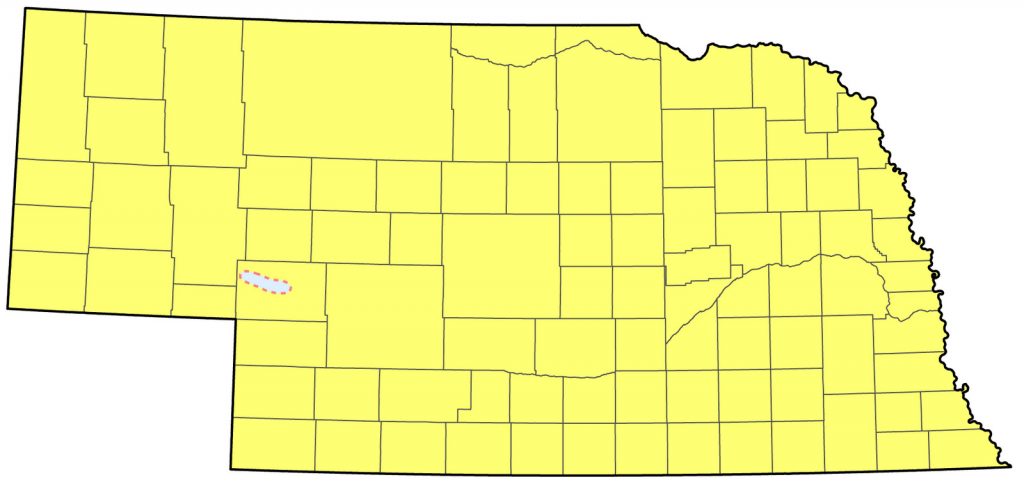
Documentation: Photograph: 28 Feb 1994 Lake McConaughy, Keith Co (Gubanyi 1996).
Taxonomy: Five subspecies are currently recognized by many current authorities, three in Eurasia (fuscus, heuglini, and barabensis), and two that occur in both North America and Europe, graellsii and intermedius (AviList 2025).
Taxonomy of this species and close congeners continues to be complex and controversial. We (and AviList) follow Collinson et al (2008) in recognizing five subspecies, although Howell and Dunn (2007) and Harrison et al (2021) cite studies that suggest only three subspecies comprise Lesser Black-backed Gull, fuscus, intermedius, and graellsii. Harrison et al (2021) treated heuglini and barabensis (“Steppe Gull”) as subspecies of nominate heuglini (Heuglin’s Gull) and suggested that fuscus may be a separate species as well.
Most North American reports are referable to graellsii (Howell and Dunn 2007); intermedius has occurred only rarely in northeast North America. However, Olsen and Larssen (2004) indicated that North American birds resemble both graellsii and Intermedius and comprise a cline.
Nebraska reports are presumed graellsii, although darkest-mantled individuals may be closer to intermedius.
Spring: winter <<<>>> Apr 20, 23, 23 (away from Keith Co)
Later dates away from Keith Co are 4 May 2024 Lancaster Co, and 5 May 2022 Douglas Co.
Most spring reports are of adults.
Of about 254 total records as of Dec 2020 (eBird.org), 125 were Feb-Apr, half of these in Mar.
First recorded in Nebraska in 1992 (Morris 1992), Lesser Black-backed Gulls have been reported every year since, except for 1993. There are now numerous records, qualifying the species for regular status in Nebraska.
- High counts: 27 at Lake McConaughy, Keith Co 20 Mar 2026, 15 there 26 Apr 2021, 9 there 18 Mar 2020, 8 at Branched Oak Lake, Lancaster Co 3 Apr 2023, and 8 at Lake McConaughy 29 Apr 2025.
In 2014, 16 were reported statewide Mar-May, 19 in 2015, 21 in 2020, and 25 in 2024.
Summer: There are about 39 records from 6 May-1 Sep, all but one (see below) at Lake McConaughy, and almost all non-breeding immatures.
There was a notable influx of immatures in 2024, with 12 there 2 Jun, dwindling to 1-2 thereafter through 31 Jul, increasing to eight on 23 Aug.
The only record 6 May-2 Sep away from Lake McConaughy is of a third cycle immature photographed at Merritt Reservoir SRA, Cherry Co 23 Jul-11 Aug 2014 (Silcock 2014a, 2014b).
Fall: Sep 21, 23, 23 <<<>>> winter (away from Keith Co)
Earlier dates away from Keith Co are 2 Sep 2025 Lancaster Co, 3-6 Sep 2024 Scotts Bluff Co, 4 Sep 2025 Scotts Bluff Co, 5-27 Sep 2016 Lancaster Co, 12 Sep 2025 Sheridan Co, and 15 Sep 2022 Dixon Co.
- High counts: 22 at Lake McConaughy, Keith Co 26 Sep 2024, 13 there 14 Nov 2022, and 6 there 18 Nov 2020.
Winter: Most reports for Sep- Apr are for Keith Co, although there are numerous reports at larger reservoirs elsewhere.
Of 26 counted at Lake McConaughy, Keith Co 8 Dec 2025, “almost all” were adults with no first cycle birds noted (Mlodinow, eBird.org).
Although most interior Lesser Black-backed Gulls winter on the Gulf Coast (Dunn and Alderfer 2017), a few occur northward; it is listed as a “rare winter visitant” in Kansas (Thompson et al 2011).
- High counts: 30 at Lake McConaughy, Keith Co 1 Dec 2023, 29 there 9 Dec 2020, and 26 there 8 Dec 2025.
Comments: Lesser Black-backed Gull was first recorded in North America in 1934 and has increased in numbers remarkably since the 1970s, a reflection of a similar increase in Europe (Olsen and Larsson 2004). As of 2007, there were only two records of Lesser Black-backed Gull breeding in North America, in Maine and Alaska; in both cases the birds were paired with Herring Gulls (Ellis et al 2007). Lesser Black-backed Gull was first noticed in Greenland in the 1980s, and breeding was confirmed in 1990; since then, two breeding populations have established in southwestern Greenland (Boertmann 2008). A recent study concluded that although at one time Iceland acted as a source population for North American vagrant Lesser Black-backed Gulls, more recently the fast-growing Greenland population has become the primary source (Zawadski et al 2021).
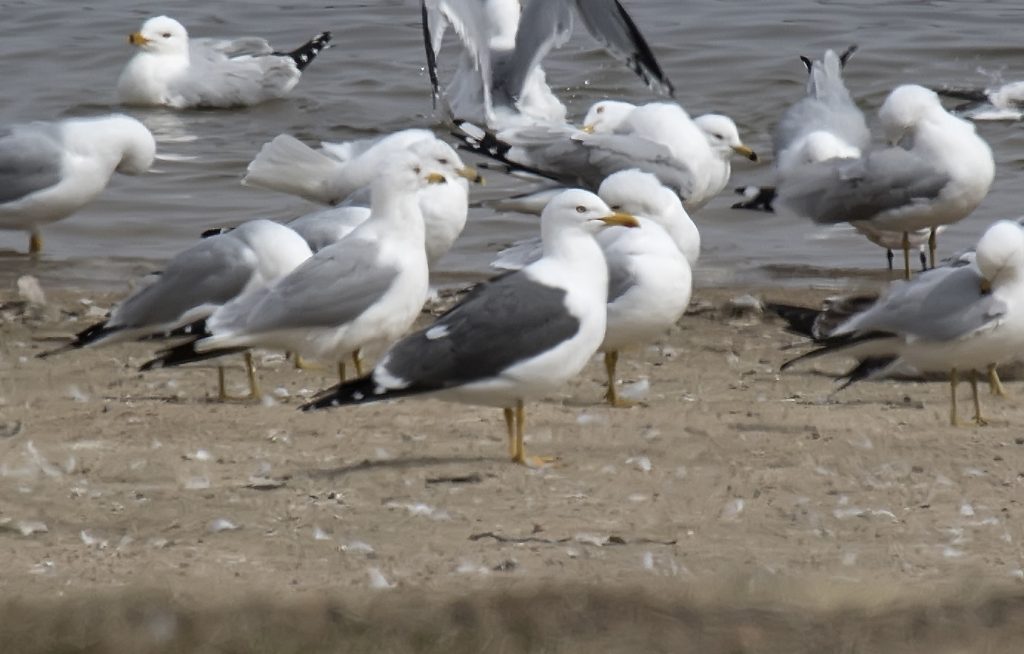
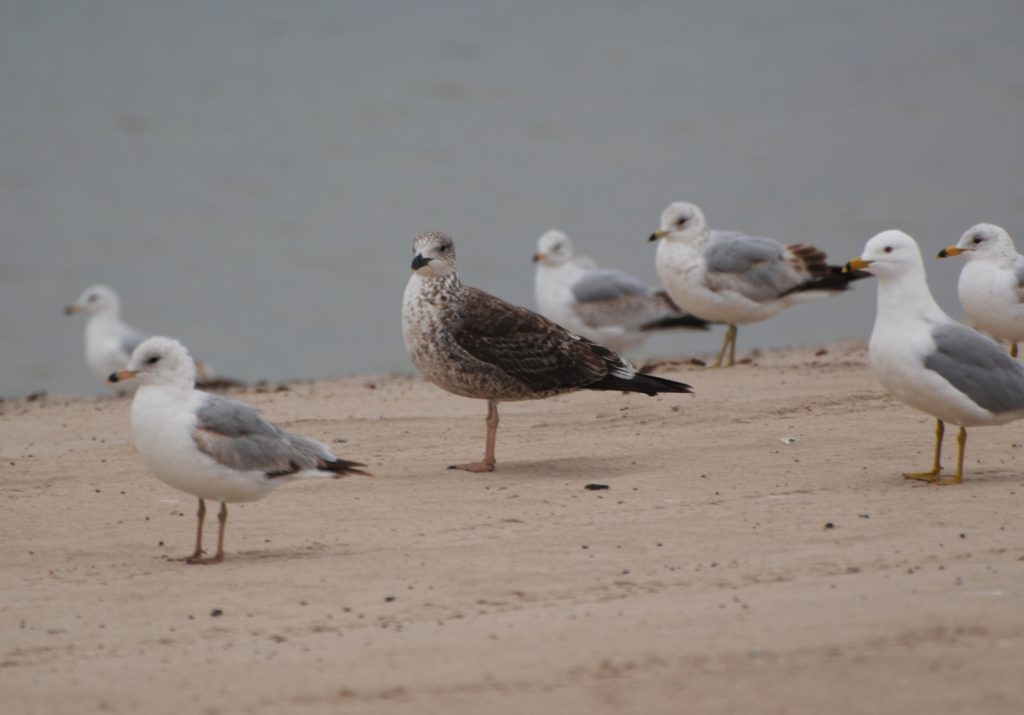
Images
Abbreviations
SRA: State Recreation Area
Literature Cited
AviList Core Team, 2025. AviList: The Global Avian Checklist, v2025. https://doi.org/10.2173/avilist.v2025.
Boertmann, D. 2008. The Lesser Black-backed Gull, Larus fuscus, in Greenland. Arctic 61: 129-133.
Collinson, J.M., D.T. Parkin, A.G. Knox, G. Sangster, and L. Svensson. 2008. Species boundaries in the Herring and Lesser Black-backed Gull complex. British Birds 101: 340–363.
Dunn, J.L., and J. Alderfer. 2017. Field Guide to the birds of North America, National Geographic Partners LLC, Washington, DC.
Ellis, J.C., M.C. Stoddard, and L.W. Clark. 2007. Breeding by a Lesser Black-backed Gull (Larus fuscus) on the Atlantic coast of North America. North American Birds 61: 546-548.
Gubanyi, J.G. 1996. 1994 (Sixth) Report of the NOU Records Committee. NBR 64: 38-42.
Harrison, P. , M. Perrow, and H. Larsson. 2021. Seabirds. The New Identifcation Guide. Lynx Edicions, Barcelona.
Howell, S.N.G., and J. Dunn. 2007. Gulls of the Americas. Houghton Mifflin Harcourt, New York, New York, USA.
Morris, R. 1992. Spring 1992 Occurrence Report. NBR 60: 79-149.
Olsen, K.M., and H. Larsson. 2004. Gulls of Europe, Asia and North America. Princeton: Princeton University Press.
Silcock, W.R. 2014a. Summer Field Report, June-July 2014. NBR 82: 98-121.
Silcock, W.R. 2014b. Fall Field Report, August-November 2014. NBR 82: 150-181.
Thompson, M.C., C.A. Ely, B. Gress, C. Otte, S.T. Patti, D. Seibel, and E.A. Young. 2011. Birds of Kansas. University Press of Kansas, Lawrence, Kansas, USA.
Zawadzki, L.C., G.T. Hallgrimsson, R.R. Veit, L.M. Rasmussen, D. Boertmann, N. Gillies, and T. Guilford. 2021. Predicting Source Populations of Vagrants Using Breeding Population Data: A Case Study of the Lesser Black-Backed Gull (Larus fuscus). Frontiers in Ecological Evolution 03 December 2021. https://doi.org/10.3389/fevo.2021.637452.
Recommended Citation:
Silcock, W.R., and J.G. Jorgensen. 2026. Lesser Black-backed Gull (Larus fuscus graellsii). In Birds of Nebraska — Online. www.BirdsofNebraska.org
Birds of Nebraska – Online
Updated 12 Aug 2026