ANAS platyrhynchos x ANAS diazi
ANAS Diazi/ANAS PLATYRHYNCHOS x ANAS DIAZI
Status: Rare casual summer visitor
Taxonomy: Recent genetic studies by Lavretsky et al (2019) and Brown et al (2022) have detected genetic hybrids between Mexican Duck and Mallard in the southwestern US, usually in areas where feral Mallards occur. The percentage of hybrids in these studies was low, some 2-5%.
More recently, Mexican Duck-like birds reported as Mexican Duck, Mexican Duck x Mallard (hybrid), and Mexican Duck/Mallard have increased markedly northward on the Great Plains; respective total reports in eastern Wyoming, eastern Colorado, western Nebraska, and western Kansas for these three reporting options are 27, 33, and 34 (eBird.org, accessed Jul 2026).
Complicating reporting of Mexican Duck-like birds showing at least one Mallard character are four possible options: a phenotypic Mexican Duck, an older adult male Mexican Duck expressing Mallard traits due to declining testosterone levels, a Mexican Duck x Mallard (F1 hybrid), and F2 and subsequent introgressants. The records listed here were reported to eBird as “Mexican Duck x Mallard (hybrid)” and accepted as such (eBird.org, accessed Jul 2026) but any or all may be any one of the three possible options noted above.
It should be noted that of seven reported Mexican Ducks reported in Nebraska, only one was accepted, the others not accepted by NOURC. The six not accepted reports might well be re-assigned as one of the three options listed above: an older adult male Mexican Duck expressing Mallard traits due to declining testosterone levels, a Mexican Duck x Mallard (F1 hybrid), and F2 and subsequent introgressants. A recent article suggested waterfowl hunters submit samples from Mexican Duck-like birds for DNA analysis (Jorgensen and Brenner 2026).
Records: There are nine records:
26 Apr 2023 Scotts Bluff Co (Mlodinow, eBird.org)
18 May-3 Jun 2026 Scottsbluff WTP, Scotts Bluff Co (Mlodinow, eBird.org)
20 Jul 2013 photograph Clay Co (Paul Dunbar, personal communication)
30 Oct 2024 Cochran Lake, Scotts Bluff Co (Mlodinow, eBird.org)
11 Nov 2025 shot by hunter Hitchcock Co (fide Logan Sanders- see Comments)
12 Nov 2019 photograph Sioux Co (Mlodinow, eBird.org)
6-13 Dec 2025 Highway 26, Scotts Bluff Co (Mlodinow, eBird.org)
14 Dec 2021 Cochran Lake, Scotts Bluff Co (Mlodinow, eBird.org)
30 Jan 2024 Garden Co (Mlodinow, eBird.org).
Comments: The Hitchcock Co record included a photo of the specimen; its DNA was analyzed by the Lavretsky lab and consisted of 78% Mexican Duck and 22% Wild Mallard DNA and judged to be an F2 hybrid.
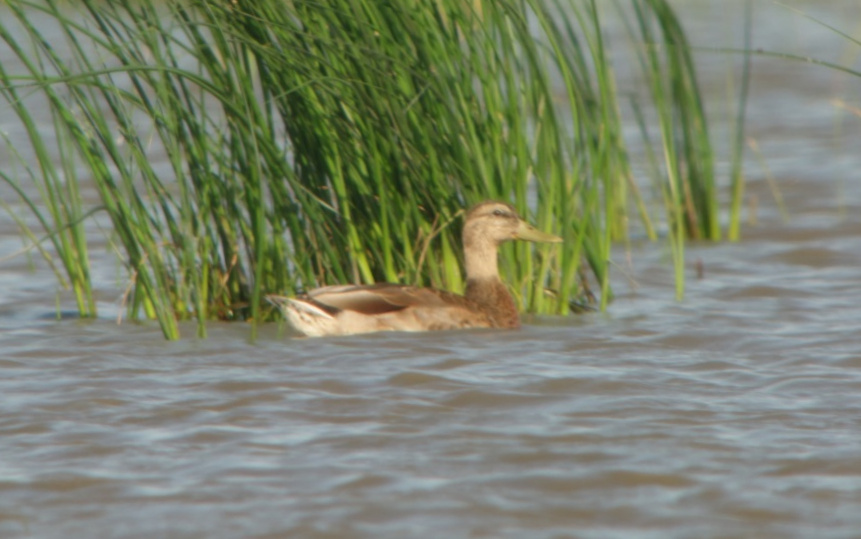
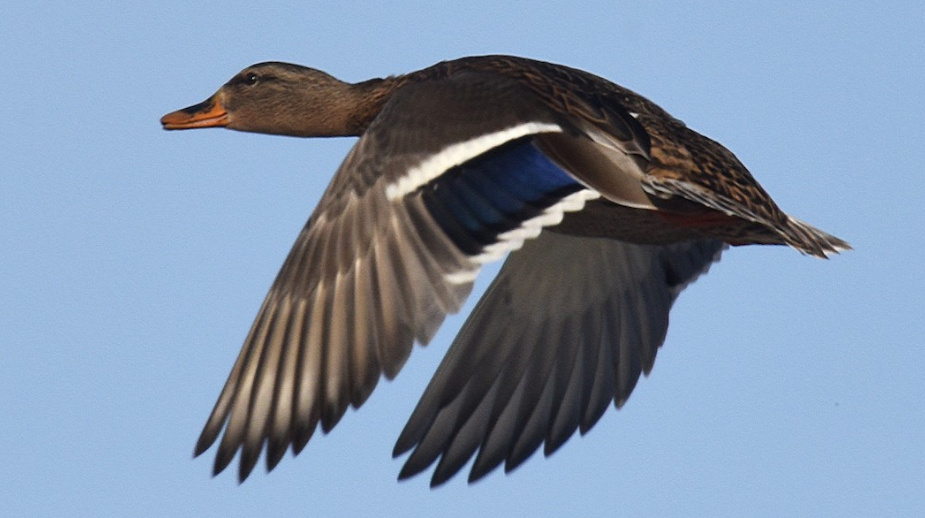
Regarding the Sioux Co record cited above (photograph herein), observer Steven Mlodinow noted in his eBird checklist: “Too dark for MALL with tail that is too dark. However, relatively broad edges to speculum, heavy black splotching on bill, and amount of white on tail not correct for pure [Mexican Duck]. Perhaps if only one mark was off, but the combo pretty much eliminates a pure bird.” Mlodinow further commented: “I ran it past some NM/AZ birders as well as Andy Engilis, who is doing work on Mexican and Mottled Ducks, establishing phenotypes of each taxa using genes (from the birds studied) to confirm ID. The answer was Mexican x Mallard, as I expected, with the caveat (from Engilis) that it is possible that some pure Mexican Ducks might look like this.”
The Cochran Lake bird, a male, was described by the observer: “Male MALL like bird with weakly mottled brownish sides and head colored green and brown in Baikal Teal like pattern. Bill bright yellow with black nail. Not as dark as MALL X ABDU.”
A dark female paired with a male Mallard 20 Jun 1993 Sioux Co and reported by Ross Silcock as an American Black Duck: “Most unusual for season and location was an Am. Black Duck in Sioux NE June 20 (RS)” (Grzybowski 1993), may have been a Mallard x Mexican Duck hybrid based on current knowledge.
It is likely as Nebraska observers become more familiar with these taxa there will be additional reports, presumably westward. The presence of Mexican Duck and its various crosses with Mallard is well-documented in eastern Colorado north of the Arkansas River (eBird.org, accessed Apr 2026).
Of the several Colorado records of Mallard X Mottled Duck along the Colorado Front Range, at least two observers noted the challenge of separating this hybrid from Mallard X Mexican Duck (eBird.org, accessed Nov 2023).
Images
Literature Cited
Brown, J.I., F. Hernández, A. Engilis Jr., Blanca E. Hernández‑Baños, D. Collins, and P. Lavretsky. 2022. Genomic and morphological data shed light on the complexities of shared ancestry between closely related duck species. Scientific Reports 12:10212. https://doi.org/10.1038/s41598-022-14270-2.
Grzybowski, J.A. 1993. The Summer Season June 1-July 31, 1993. American Birds 47: 1122-1124.
Jorgensen, J.G., and S.J. Brenner. 2026. The Mexican Duck Dilemma. Nebraskaland November 2026: 14-15.
Lavretsky, P., T. Janzen, and K.G. McCracken. 2019. Identifying hybrids & the genomics of hybridization: Mallards & American black ducks of Eastern North America. Ecology and Evolution 9: 3470-3490. https://doi.org/10.1002/ece3.4981Citations: 10.
Thompson, M.C., C.A. Ely, B. Gress, C. Otte, S.T. Patti, D. Seibel, and E.A. Young. 2011. Birds of Kansas. University Press of Kansas, Lawrence, Kansas, USA.
Recommended Citation
Silcock, W.R., and J.G. Jorgensen. 2026. Mallard x Mexican Duck (hybrid) (Aythya platyrhynchos x diazi). In Birds of Nebraska — Online. www.BirdsofNebraska.org
Updated 13 Oct 2026