Cistothorus palustris plesius, C. p. iliacus
Status: Fairly common regular spring and fall migrant statewide. Common regular breeder north and west (western song type). Uncommon regular breeder northeast, rare southeast (May-Jun; eastern song type). Uncommon regular breeder east and east-central (Jul-Aug; eastern song type, late summer breeders). Rare regular winter visitor west and south, rare casual north and east.
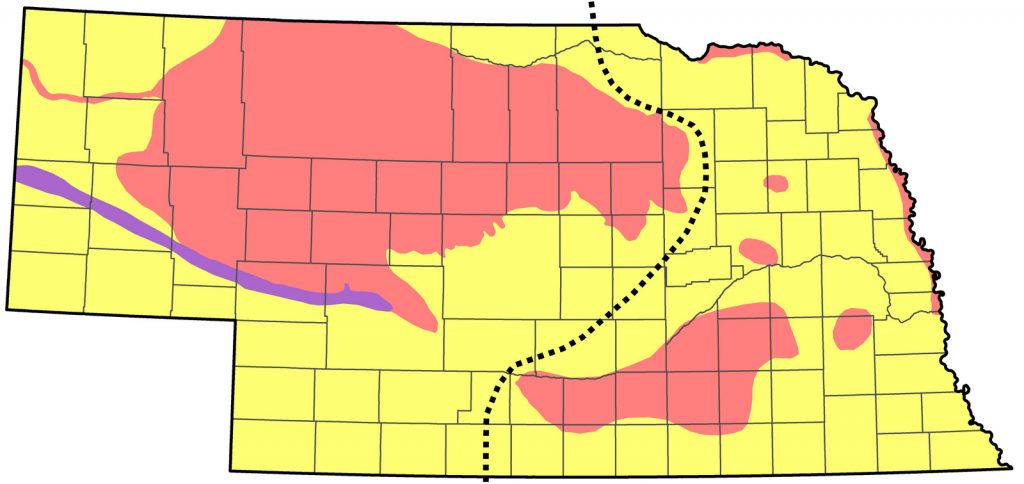
Dashed line separates breeding ranges of western and eastern groups of Marsh Wren (see Taxonomy).
Documentation: Specimen: iliacus, UNSM ZM11653, Lancaster Co 5 May 1917; plesius, UMMZ 72431, Hackberry Lake, Cherry Co 6 Jul 1933.
Taxonomy: Fifteen subspecies are recognized (AviList 2025); subspecies most likely to occur in Nebraska based on ranges are plesius of southeastern Idaho to south-central Colorado, Nebraska, and probably to New Mexico, wintering to central Mexico, and iliacus of south-central Canada to central US, wintering to Gulf Coast.
Kroodsma and Verner (1987) and Kroodsma (1989) found two “large evolutionary groups”, western and eastern song types, and suggested these may be separate species based on a significant degree of assortative mating where their ranges meet in Saskatchewan and possibly in Nebraska. Subspecies plesius was included in the western song type group, and iliacus was included in a western part of the eastern group described as “Straddling or adjacent to the overlap zone between eastern and western Marsh Wren groups”.
Kroodsma (1988) found two demonstrably different Marsh Wren song types in Nebraska that were apparently separated by a 65 mile-wide “wrenless” corridor containing little or no suitable breeding habitat. This corridor extended southeastward from the South Dakota line through Boyd and Holt Cos, effectively isolating wrens from Sandhills marshes to the west (plesius) from birds of northeastern Nebraska marshes (iliacus). Later, however (Kroodsma and Verner 2020), considered this “wrenless” corridor part of an “overlap zone” between the two song types; eastern song type birds occur to some degree west of the corridor among western song types (Kroodsma 1988, Robbins 2014). All singing birds found in summer in the eastern Rainwater Basin have been eastern types (Jorgensen 2012).
In summary, breeding Marsh Wrens in most of Nebraska are plesius (Western Marsh Wren), occurring east to and within the overlap zone between Eastern and Western Marsh Wren groups, and iliacus (Eastern Marsh Wren), within the overlap zone and presumably eastward. No other subspecies have been reported for Nebraska.
Reports of eastern iliacus in the range of western plesius are 21 May 2010 (2) Spalding, Greeley Co, 3 Jun 2011 (3) Goose Lake, Holt Co (Robbins 2014), 14 Jun 2021 Scotts Bluff Co, 26 Jun 2010 Milburn Dam WMA, Blaine Co, and 11 Sep 2015 on Beaver Creek, Wheeler Co. There are a few records of Eastern Marsh Wren in eastern Colorado (Steven Mlodinow, personal communication).
Reports of western plesius in the range of eastern iliacus are probably of migrants: 6 May 2013 Butler Co, 2 Jun 2019 Knox Co, 4 Aug 2019 Knox Co, and 28 Aug 2020 Adams Co.
Spring: Mar 29, 30, Apr 1 <<<>>> summer
Early dates above are for the north and east; most are probable migrants but a few may have wintered (see Winter). Earlier dates in the north and east that are probably migrants are 18 Mar 2018 Valentine NWR, Cherry Co, 19 Mar 2023 Lancaster Co, and 21 Mar 2020 Lancaster Co. See Winter for earlier dates.
Arrival in the north and east is generally in early Apr, such as the seven along Road 81 near Crescent Lake NWR, Garden Co 3 Apr 2024.
Data from the southern two rows of counties in Nebraska, where Marsh Wrens do not breed, indicate that the last spring migrants pass through by mid-May. Reports after mid-May away from known breeding areas but in suitable habitat suggest breeding attempts; most other such reports are likely of tardy migrants.
There are occasional reports of singing western subspecies plesius in the east, presumably migrants moving north to their breeding range.
- High counts: 25 at Fontenelle Forest, Sarpy Co 6 May 2023, 20 at Crescent Lake NWR, Garden Co 24 May 2025, and 20 at Clear Creek Marshes, Garden Co 31 May 2026.
Summer: On a statewide basis, Marsh Wrens breed commonly north of the southernmost two rows of counties (eBird.org, accessed Nov 2023; Sauer et al 2017); highest densities are in the western Sandhills, and lowest in the northeast. Good numbers breed at Wood Duck WMA, Stanton Co. Apart from the Rainwater Basin, where the species is believed to breed, there is only one mid-May through Aug record in the southernmost two rows of counties, 21 Jun 2016 Frontier Co.
Evidence is accumulating that Eastern Marsh Wrens may colonize some nesting sites in the south and east in late summer rather than upon arrival in spring, a pattern not dissimilar from Sedge Wren (see that species). Most arrive mid-Jul; there are numerous reports of Marsh Wrens arriving and singing vigorously in marshes where they were absent May through mid-Jul. In the Rainwater Basin, Jorgensen (2012) stated “generally absent in early summer (June); singing birds are usually located later in July and August at sites where they were absent earlier”. Relatively late-season breeding was observed in “atypical” habitat in Lancaster Co 26 Aug 1970 (Cink and Fiala 1971) and the presence of a newly-fledged young bird with an agitated adult at Jack Sinn WMA, Saunders Co, 22 Sep 2007 was confirmation of breeding there. This pattern has not been observed in western song type Marsh Wrens in Nebraska (Robbins 2015).
- Breeding phenology:
Nest building: 26 Apr-19 Jun
Eggs: 26 May- 15 Jul (Mollhoff 2022)
Nestlings: 3 Jun-14 Jul
Fledglings: 22 Sep
- High counts: 110 at Crescent Lake NWR, Garden Co 26 Jul 1995, 100 there 26 May 2018, and 72 there 19 May (no year given).
Fall: summer <<<>>> Dec 5, 7, 8
Later dates of birds apparently attempting to winter are 12-14 Dec 2018 Lancaster Co, 18 Dec 2017 Sarpy Co, and 23 Dec 2024 Jefferson Co. See winter for later dates.
Birds begin to leave breeding grounds during Aug (Kroodsma and Verner 2020) and peak “true” migration probably occurs in the second half of Sep and early Oct; Johnsgard (1980) found that half the fall reports were in the period 8 Sep-10 Oct. Tout (1947) stated that his earliest fall date was 19 Sep. Migration ends by mid-Nov.
- High counts: 18 at Marsh Wren Community Wetlands, Lancaster Co 2 Oct 2021, and 15 at Little Salt Fork Marsh, Lancaster Co 11 Oct 2014.
Winter: The winter range of this species, presumably western subspecies plesius, is primarily to the southwest of Nebraska, but low numbers of Marsh Wrens attempt to overwinter in the Panhandle and south most years, especially in the vicinity of Lake McConaughy in Keith and southeast Garden Cos (Rosche 1994, Grzybowski 1994).
Winter reports (24 Dec-17 Mar) in the north and east are less than annual: 29 Dec 2016 Lancaster Co, 31 Dec 2022 Loup Co, 8 Jan 2023 Jefferson Co, 9 Jan 2013 Boone Co, 16 Jan 2007 Cedar Co, 20-21 Feb 2019 Nuckolls Co, 27 Feb 2004 Cherry Co, 9 Mar 2017 Sarpy Co, and 14 Mar 2016 Seward Co.
Images
Abbreviations
CBC: Christmas Bird Count
NWR: National Wildlife Refuge
SRA: State Recreation Area
UMMZ: University of Michigan Museum of Zoology
UNSM: University of Nebraska State Museum
WMA: Wildlife Management Area (State)
Literature Cited
AviList Core Team, 2025. AviList: The Global Avian Checklist, v2025. https://doi.org/10.2173/avilist.v2025.
Cink, C.L., and K.L. Fiala. 1971. Breeding record of the Long-billed Marsh Wren from Lancaster County. NBR 39: 74-75.
Grzybowski, J.A. 1994. Southern Great Plains Region. American Birds 48: 313-315.
Johnsgard, P. A. 1980. A preliminary list of the birds of Nebraska and adjacent Great Plains states. Published by the author, University of Nebraska, Lincoln, USA.
Jorgensen, J.G. 2012. Birds of the Rainwater Basin, Nebraska. Nebraska Game and Parks Commission, Lincoln, Nebraska, USA.
Kroodsma, D.E. 1988. Two species of Marsh Wren (Cistothorus palustris) in Nebraska? NBR 56: 40-42.
Kroodsma, D.E. 1989. Two North American song populations of the Marsh Wren reach distributional limits in the central Great Plains. Condor 91: 332-340.
Kroodsma, D.E., and J. Verner. 1987. Use of song repertoires among Marsh Wren populations. Auk 104: 63-72.
Kroodsma, D.E., and J. Verner. 2020. Marsh Wren (Cistothorus palustris), version 1.0. In Birds of the World (A. F. Poole, Editor). Cornell Lab of Ornithology, Ithaca, NY, USA. https://doi.org/10.2173/bow.marwre.01.
Mollhoff, W.J. 2022. Nest records of Nebraska birds. Nebraska Ornithologists’ Union Occasional Paper Number 9.
Robbins, M.B. 2014. Contact zone of the Eastern and Western Marsh Wrens in Nebraska revisited. NBR 82: 128–130.
Robbins, M.B. 2015. Intra-Summer Movement and Probable Dual Breeding of the Eastern Marsh Wren (Cistothorus p. palustris); a Cistothorus Ancestral Trait? Wilson Journal of Ornithology 127: 494-498.
Rosche, R.C. 1994. Birds of the Lake McConaughy area and the North Platte River valley, Nebraska. Published by the author, Chadron, Nebraska, USA.
Sauer, J.R., D.K. Niven, J.E. Hines, D.J. Ziolkowski, Jr, K.L. Pardieck, J.E. Fallon, and W.A. Link. 2017. The North American Breeding Bird Survey, Results and Analysis 1966 – 2015 (Nebraska). Version 2.07. USGS Patuxent Wildlife Research Center, Laurel, Maryland, USA.
Tout, W. 1947. Lincoln County birds. Published by the author, North Platte, Nebraska, USA.
Williams, F. 1983. Southern Great Plains Region. American Birds 37: 314-317.
Recommended Citation
Silcock, W.R., and J.G. Jorgensen. 2026. Marsh Wren (Cistothorus palustris). In Birds of Nebraska — Online. www.BirdsofNebraska.org
Birds of Nebraska – Online
Updated 7 Sep 2026