Buteo lineatus lineatus
Status: Increasing. Uncommon regular resident southeast, rare northeast and Platte River Valley west to Buffalo Co, rare casual elsewhere.
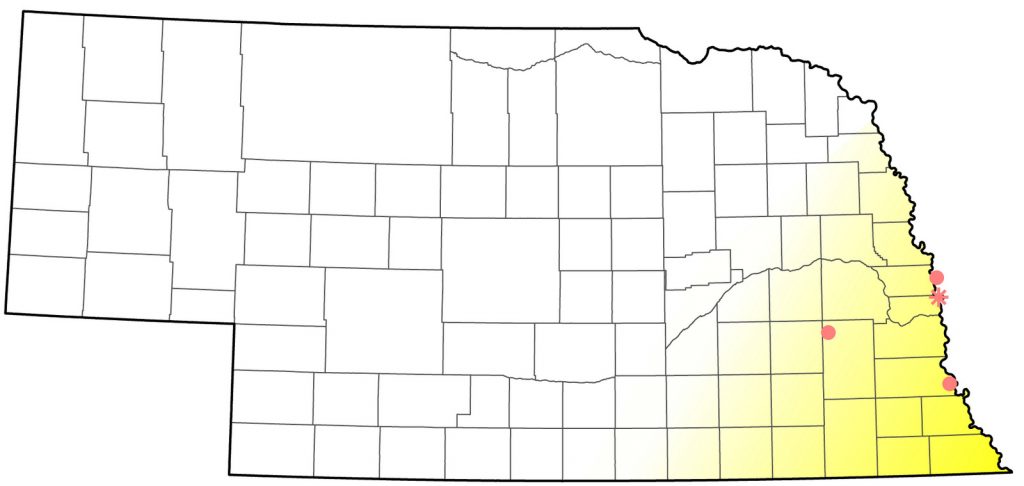
Documentation: Specimen: UNSM ZM12519, 15 Jan 1941 Fontenelle Forest, Sarpy Co.
Taxonomy: Five subspecies are recognized (AviList 2025): alleni of south-central Texas to North Carolina and northern Florida, extimus of south Florida and the Florida Keys, texanus from south Texas to southeast Mexico, elegans from southern Oregon to Baja California, and lineatus of eastern North America.
It has been proposed based on genetic analyses (Barrowclough et al 2019, Gill et al 2024) that the five subspecies be treated as three full species: California Red-shouldered Hawk (elegans), Florida Red-shouldered Hawk (extimus), and Red-shouldered Hawk (lineatus, alleni, texanus).
Nebraska breeders are presumed lineatus (Dykstra et al 2020).
An albino specimen from Loomis, Phelps Co 12 Aug 1954 is HMM 28383.
Resident: Although there is no information such as banding data to confirm that breeding birds in Nebraska are resident, Dykstra et al (2020) show that the species is resident north in the Missouri River Valley to extreme southeast Nebraska. Data in eBird show no major seasonal shifts in number of reports, although there are fewer in summer, possibly because this species is harder to locate in leafed-out woodlands during the breeding season.
This species continues to establish in southeastern Nebraska. There are about 131 total reports through May 2026, 91 of these since 2022 (eBird.org, accessed Jun 2026). Of the 40 reports before 2023, 16 were from Fontenelle Forest, Sarpy Co. Numbers reported in Mar-May have increased steadily since 2022: 11 in 2023, 18 in 2024, 21 in 2025, and 41 in 2026.
There are no reports for the west, and only these few for the north and western Platte River Valley: 9 Apr 2025 Lincoln Co, 14 Apr 1994 Cherry Co, 20 Apr 2025 western Knox Co, 11 May 2012 Lincoln Co, 28 May 2019 Brown Co, and 12 Nov 2025 Howard Co.
Bruner et al (1904) described the species as “not uncommon” along the Missouri River bluffs and nesting during this time was reported, albeit without details, by Bruner (1901) from Omaha, Steven’s Creek near Cheney (now part of Lincoln), and Nebraska City. Carriker (1900) considered the species “quite rare” in Otoe County but did describe finding a nest in a wooded area along Camp Creek about 12 miles south of Nebraska City. A nest was observed near Carter Lake, Douglas Co, 13 Apr-10 May 1959; this nest was abandoned although followed by possible renesting nearby 18 May-29 Jun; no evidence of successful breeding was noted, possibly because of crowds observing two separate human drownings at the lake (Cortelyou 1959). Fontenelle Forest was the most consistent location for breeding activity for many years; Red-shouldered Hawks nested somewhat regularly throughout the 20th century. Nesting there recommenced in 1989 after having last been reported in 1964 (Cortelyou 1965), with more recent activity limited to a single pair, but has not been reported since 2000.
Breeding records noted above for extreme southeastern Nebraska, in Lancaster, Otoe, Douglas, and Sarpy Cos, were the only such records cited by Ducey (1988). Fontenelle Forest was the most consistent location for breeding activity for many years; Red-shouldered Hawks nested somewhat regularly throughout the 20th century. Nesting there recommenced in 1989 after having last been reported in 1964 (Cortelyou 1965), with more recent activity limited to a single pair, but has not been reported since 2000. Of interest, however, were sightings of single birds 27 Mar-16 Apr 2009, and a pair was in the area of Fontenelle Forest in 2013, seen circling there 30 Jun, and nearby over Bellevue 14 Jul. A pair over Omaha 2 Aug 2015 may have been based at Fontenelle Forest. Nests at Fontenelle Forest have been located both on wooded upland slopes and the floodplain. Breeding activity, including courtship, has been observed as early as late Jan and fledging on 6 and 15 Jun. The only recent records for Fontenelle Forest are of an immature 1 and 11 May 2024, and at least two Mar-May 2026.
Breeding occurred for the first time in Lancaster Co in 2009; after several sightings of single birds in 2008 in the Pawnee Lake area, two birds were seen for the first time 9 Mar 2009 and breeding was confirmed with the discovery of a pair tending a nest 30 feet up in a green ash 30 Mar; two chicks were present 9 May, and four birds were seen 25 Jun. However, the chicks may have been predated, as the adults apparently deserted the area after 26 Jun (Silcock 2009). After about 15 years, breeding may have occurred again at Pawnee WMA; a series of sightings there 1 Mar-6 May 2024 included a bird carrying possible nest material 17 Apr. One adult was present 17 Jun 2025, and a pair and a single attempting a territory were at Pawnee Lake SRA, Lancaster Co 26 Feb10 Mar 2026. No breeding activity was observed subsequently in 2026. At Pioneers Park, an adult was seen 5 Mar 2024 and was joined by a one-year-old 12 Apr; this pair was present at least though 7 Nov, but no young were noted. In 2025 no breeding activity was observed, and in 2026 a pair was present through 28 Mar, but not thereafter.
A California study found about 10% of Red-shouldered Hawk pairings involve a yearling and nearly all of these were females (Wiley 1975); these pairings likely occur more frequently in “depleted or expanding populations or when not otherwise density limited” (Tordoff and Redig 1997).
A new nesting site was at Stanton Lake, Richardson Co, where 1-2 birds were present 14 Mar to at least 24 May 2024, including nest-building 17 Apr, an adult carrying food to the nest 17 May, and two adults tending two nestlings 10 Jun.
Additional breeding season reports at apparently suitable locations for nesting extend north to Thurston and Dakota Cos: two were in Thurston Co at Ashford Scout Camp 11-13 Jun 2006, 23 Feb 2013, and 5 Aug 2015, and a single was at Basswood Ridge WMA, Dakota Co 21 Jul 2020. Sightings at Crystal Cove, Dakota Co 19 Aug-30 Nov 2023, including two birds interacting 21 Aug, were suggestive. A juvenile possibly accompanied by an adult was at Indian Cave SP, Richardson Co 29 Jul 2009; oddly, breeding has not been proven at this seemingly suitable location. Breeding may occur at Rose Creek WMA, Jefferson Co; in 2016, one was recorded 3 Jun; very vocal birds were there 27 Jul 2016 and again 11 Jul 2017.
Little is known about Red-shouldered Hawk movements in Nebraska; as discussed above, most may be resident. Some dispersal from breeding locations may be of recently fledged juveniles or non-breeding immatures, although a small number of migrants may occur. The Hitchcock Nature Center Hawk Watch, Pottawattamie Co, Iowa has recorded an average of four birds per fall, occurring mid-Aug through late Nov (http://hawkcount.org). Dykstra et al (2019) found 6.7% (11 individuals) of tracked Red-shouldered Hawks dispersed >100 km (ca 65 miles) from natal nests; 9 of the 11 were <2 years of age. On 2 Mar 2026 a metal-banded bird was photographed at Oak Glen WMA, Seward Co and surprisingly apparently the same bird was photographed at Pawnee Lake, Lancaster Co 21 Mar (John Carlini, Shari Schwartz); it may have been an AHY bird banded and released by Raptor Conservation Alliance in Apr 2024 (Joel Jorgensen, personal communication).
-
- Breeding Phenology:
- Courtship: late Jan
- Nest building: 14 Mar-17 Apr
- Eggs/incubation: 1 Mar- 17 May (Mollhoff 2022)
Nestlings: 30 Apr-10 Jun - Fledglings: 6-15 Jun
There were numerous reports in winter 2024-2025 from no fewer than 12 locations (eight in Lancaster Co) involving at least 14 individuals, including sightings of two at Plum Creek Trail, Seward Co 11 and 13 Jan and at Pawnee Lake 20 Jan-1 Feb. A mix of adults and juveniles was reported; interestingly, both distributional outliers were juveniles, in Harlan Co 16 Dec and in Dodge Co 18 Dec-1 Jan. Reports in winter 2025-2026 were very similar: some 16 birds at 12 locations, six in Lancaster Co; one was on Plum Creek Trail, Seward Co 13 Feb 2026, and another at Bader Park, Merrick Co 26 Dec-20 Jan 2025-2026.
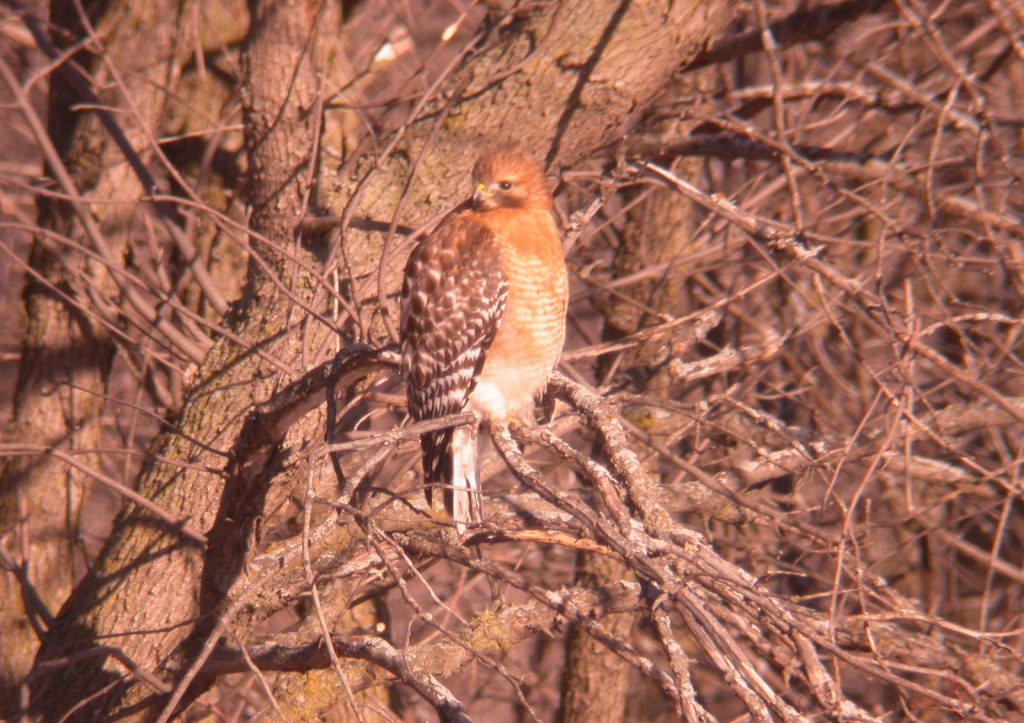
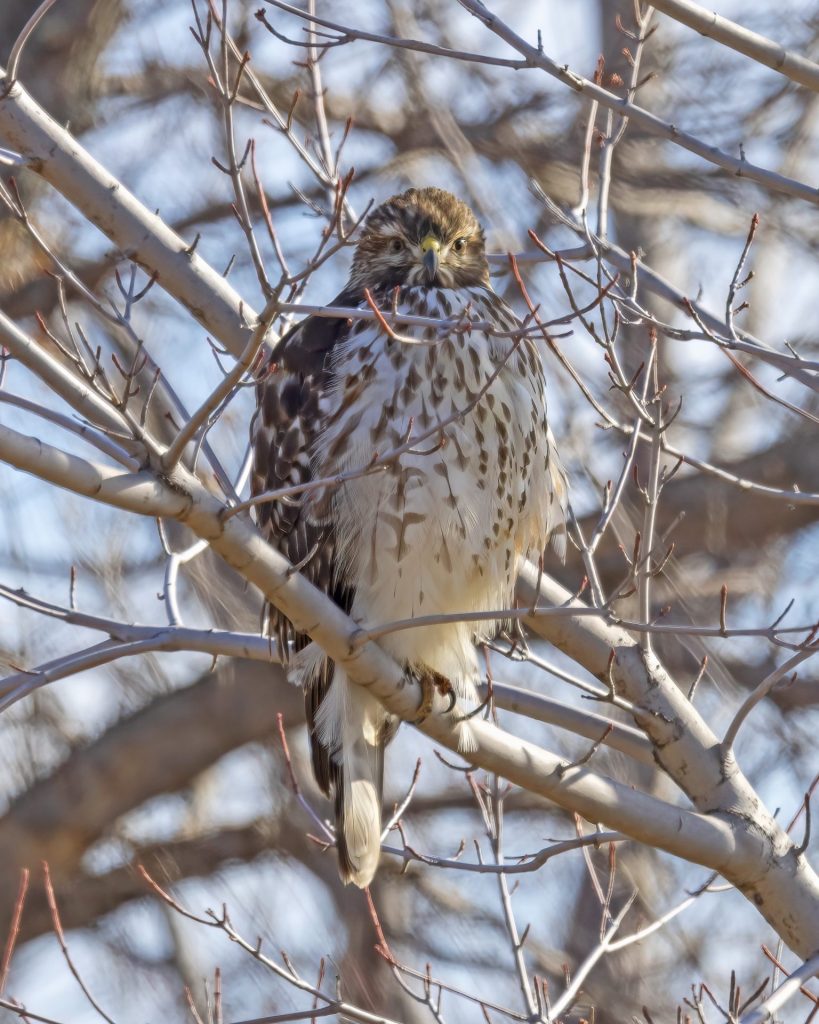
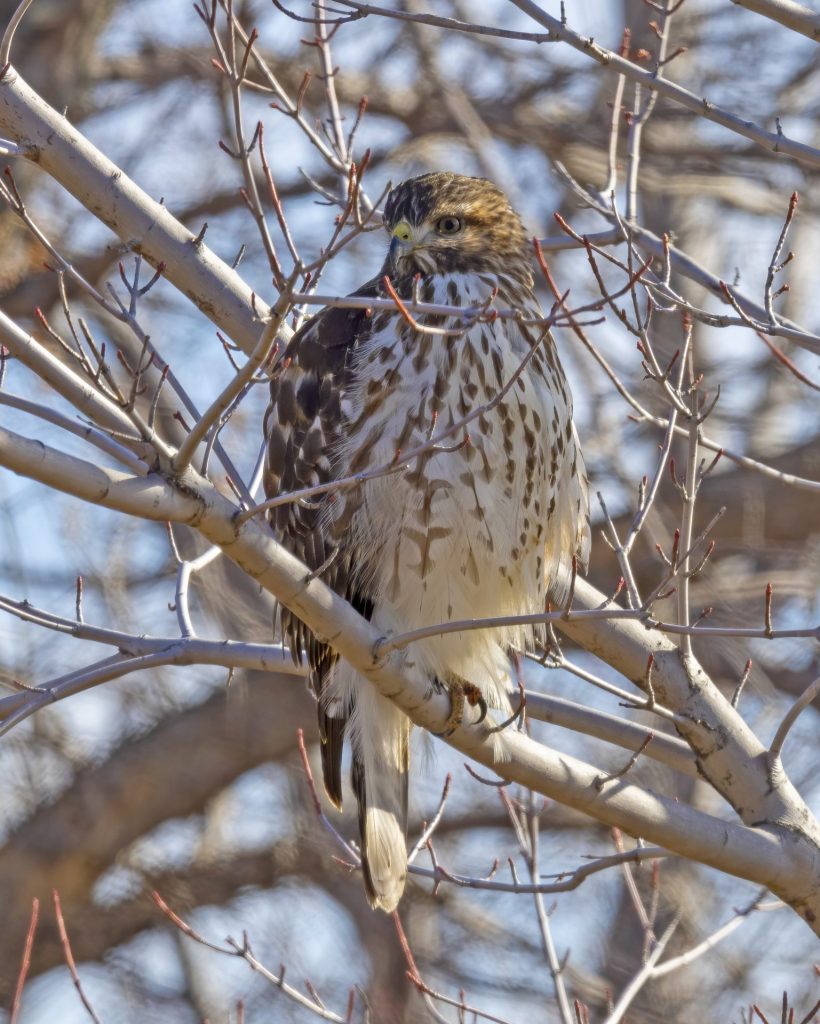
Images
Abbreviations
HMM: Hastings Municipal Museum
RA: Recreation Area
SP: State Park
UNSM: University of Nebraska State Museum
WMA: Wildlife Management Area (State)
Literature Cited
AviList Core Team, 2025. AviList: The Global Avian Checklist, v2025. https://doi.org/10.2173/avilist.v2025.
Barrowclough, G.F., J.G. Groth, W.M. Mauck, and M.E. Blair. 2019. Phylogeography and species limits in the red‐shouldered hawk (Buteo lineatus): Characterization of the Northern Florida Suture Zone in birds. Ecology and Evolution, 9: 6245-6258.
Bruner, L. 1901. Birds that nest in Nebraska. Proceedings Nebraska Ornithologists’ Union 2: 48-61.
Bruner, L., R.H. Wolcott, and M.H. Swenk. 1904. A preliminary review of the birds of Nebraska, with synopses. Klopp and Bartlett, Omaha, Nebraska, USA.
Carriker, M.A., Jr. 1900. Some notes on the nesting of the raptors of Otoe County. Proc. Nebraska Ornithologists’ Union 1: 29-34.
Cortelyou, R.G. 1959. Douglas County Notes. NBR 27: 31.
Cortelyou, R.G. 1965. Nesting Report, 1964. NBR 33: 9-13.
Ducey, J.E. 1988. Nebraska birds, breeding status and distribution. Simmons-Boardman Books, Omaha, Nebraska, USA.
Dykstra, C.R., J.L. Hays, M.M. Simon, A.R. Wegman, K.A. Williams, and L.R. Dykstra. 2019. Dispersal and Survival of Red-Shouldered Hawks Banded in Suburban Southern Ohio, 1996–2018. Journal of Raptor Research, 53: 276-292. https://doi.org/10.3356/JRR-19-15.
Dykstra, C.R., J.L. Hays, and S.T. Crocoll. 2020. Red-shouldered Hawk (Buteo lineatus), version 1.0. In Birds of the World (A. F. Poole, Editor). Cornell Lab of Ornithology, Ithaca, NY, USA. https://doi.org/10.2173/bow.reshaw.01.
Gill, F., D. Donsker, and P. Rasmussen (Eds). 2024. IOC World Bird List (v 14.2). Doi 10.14344/IOC.ML.14.2. http://www.worldbirdnames.org/
Mollhoff, W.J. 2022. Nest records of Nebraska birds. Nebraska Ornithologists’ Union Occasional Paper Number 9.
Silcock, W.R. 2009. Summer Field Report, June-July 2009. NBR 77: 94-110.
Tordoff, H.B., and P.T. Redig. 1997. Midwest Peregrine Falcon demography, 1982-1995. Journal of Raptor Research 31: 339-346.
Wiley, J.W. 1975. The nesting and reproductive success of Red-tailed Hawks and Red-shouldered Hawks in Orange County, California. Condor. 77: 133-139.
Recommended Citation
Silcock, W.R., and J.G. Jorgensen. 2026. Red-shouldered Hawk (Buteo lineatus). In Birds of Nebraska — Online. www.BirdsofNebraska.org
Birds of Nebraska – Online
Updated 7 Sep 2026