lARUS vEGAE
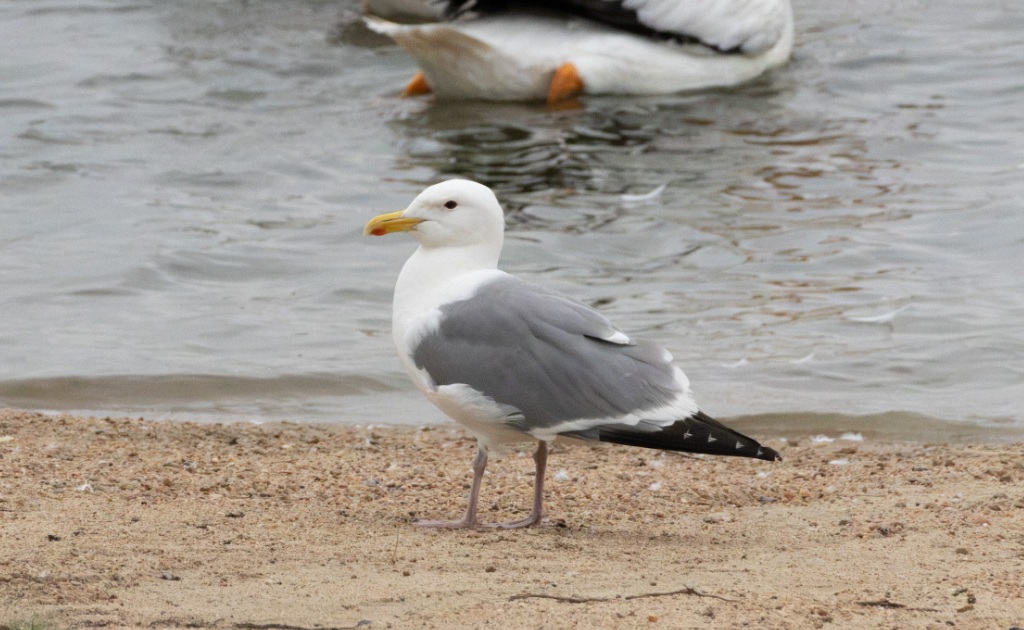
Documentation: Photographs: 19 Sep 2026 Pawnee Lake SRA, Lancaster Co by Tobin Brown (https://ebird.org/checklist/S395550836).
Status: Record currently under NOURC review.
Taxonomy: Current considerations suggest treatment of the four groups now generally recognized within traditional Herring Gull as separate species (Hebert et al 2024): L. argentatus European Herring Gull, L. smithsonianus American Herring Gull, L. vegae Vega Gull, and L. mongolicus Mongolian Gull. As noted by Hebert et al (2024), there are continuing disagreements on how these taxa should be treated; evidence for the splits includes genetic, morphological, plumage, and vocal data.
Record: An adult gull putatively identified to this species was found at Pawnee Lake SRA, Lancaster Co 19 Sep 2024 by Judson Buescher and photographed the same day by Tobin Brown; it was seen departing around 11.45 am by Brown and was not subsequently relocated (https://ebird.org/checklist/S395550836).
The photographs were referred to Amar Ayyash (author of the Gull Guide, see Ayyash 2024), who noted the following: “Intriguing bird! I really like Vega Gull over any other ID. The orbital appears orange-red (not pink, not orange-yellow). The strong, vivid yellow bill at this date with distinctive oval-shaped orange-red gonys spot, late p-molt, broad white trailing edge to the secondaries, and of course darker gray upperparts make it a suitable candidate that I could get behind. I don’t see any convincing intermediate features that would support a California x Herring hybrid (that combination is presumably quite rare and should only be seriously pursued with more intermediate birds). Great Black-backed x American Herring can superficially look like this, I guess, but that hybrid averages a bulkier bill, a paler iris and more white in the wingtip. The extensive black on the base of p7-p8 is within range for an adult type Vega.”
Comments: The Lancaster Co gull would not only be the second of Vega Gull for Oklahoma, Kansas, and Nebraska, but it would be the earliest on record, if accepted, and the lone Sep record for the US among the additional 113 total records, all from Oct-Apr.
The bird was in fresh pre-alternate plumage (Ayyash, see above) in Sep, an apparently rather early date for this plumage. However, the pre-alternate molt of non-breeding birds can begin in Sep-Oct, and is most likely to be complete prior to winter in species that tend to be long-distance migrants (Hebert et al 2024), similar to American Herring Gull (Pierotti et al 2026). Although Ayyash considered a hybrid California Gull x American Herring Gull (Chase 1984) unlikely, there are photographs of a hybrid in Colorado at https://ebird.org/checklist/S38879009 and it should be noted there is an influx of California Gulls of all age classes to the Lake McConaughy area, Keith Co, Nebraska beginning in Jul-Aug.
Vega Gull is regular in spring and fall throughout the Bering Sea region of Alaska and on the western Aleutian Islands but may occur as a “winter vagrant” on the Pacific Coast south to California (Hebert et al 2024). According to eBird (accessed Sep 2026) there are about 80 records for the US Pacific Coast from Oct-Mar, most in Dec-Feb in southern California.
There are currently 21 records accepted on eBird for the eastern US from Oct- Mar, eight from the Great Lakes area, six from the adjacent Atlantic Coast, and seven from Florida (eBird.org, accessed Sep 2026). The route followed by these eastern US birds is conjectural.
On the Great Plains there are no records north of Nebraska, none for Kansas, one for Oklahoma, Nov 2024, and 15 for Texas 20 Dec-2 Apr (eBird.org, accessed Sep 2026). The first Texas record was in 2000, and since then there were seven records from 2003-2008, 5 records from 2013-2019, and two from 2025-2026. The only other Interior records are for Utah, Feb 2011 and Feb 2022. These Southern Great Plains records suggest rare vagrancy from Alaska onto the southern plains.
Images
Abbreviations
NOURC: Nebraska Ornithologists’ Union Records Committee.
Literature Cited
Ayyash, A. 2024. The Gull Guide: North America. Princeton University Press.
Chase, C.A. III. 1984. Gull hybridization: California x Herring. Colorado Field Ornithologists’ Union Journal 18: 62.
Hebert, C.E., A.F. Poole, J.C. Ellis, P. Pyle, and M.A. Patten. 2024. Vega Gull (Larus vegae), version 1.0. In Birds of the World (B. K. Keeney and S. M. Billerman, Editors). Cornell Lab of Ornithology, Ithaca, NY, USA. https://doi.org/10.2173/bow.veggul1.01.
Pierotti, R.J., L.U. Taylor, D.V. Weseloh, C.E. Hebert, and P. Pyle. 2026. American Herring Gull (Larus smithsonianus), version 2.0. In Birds of the World (N. D. Sly, B. K. Keeney, and S. M. Billerman, Editors). Cornell Lab of Ornithology, Ithaca, NY, USA. https://doi.org/10.2173/bow.amhgul1.02.
Sonsthagen, S.A., R.E. Wilson, R.T. Chesser, J.-M. Pons, P.-A. Crochet, A. Driskell, and C. Dove. 2016. Recurrent hybridization and recent origin obscure phylogenetic relationships within the ‘white-headed’ gull (Larus sp.) complex. Molecular Phylogenetics and Evolution 103: 41-54.
Recommended Citation
Silcock, W.R., and J.G. Jorgensen. 2026. Vega Gull (Larus vegae). In Birds of Nebraska — Online. www.BirdsofNebraska.org
Birds of Nebraska – Online
Updated 28 Sep 2026